
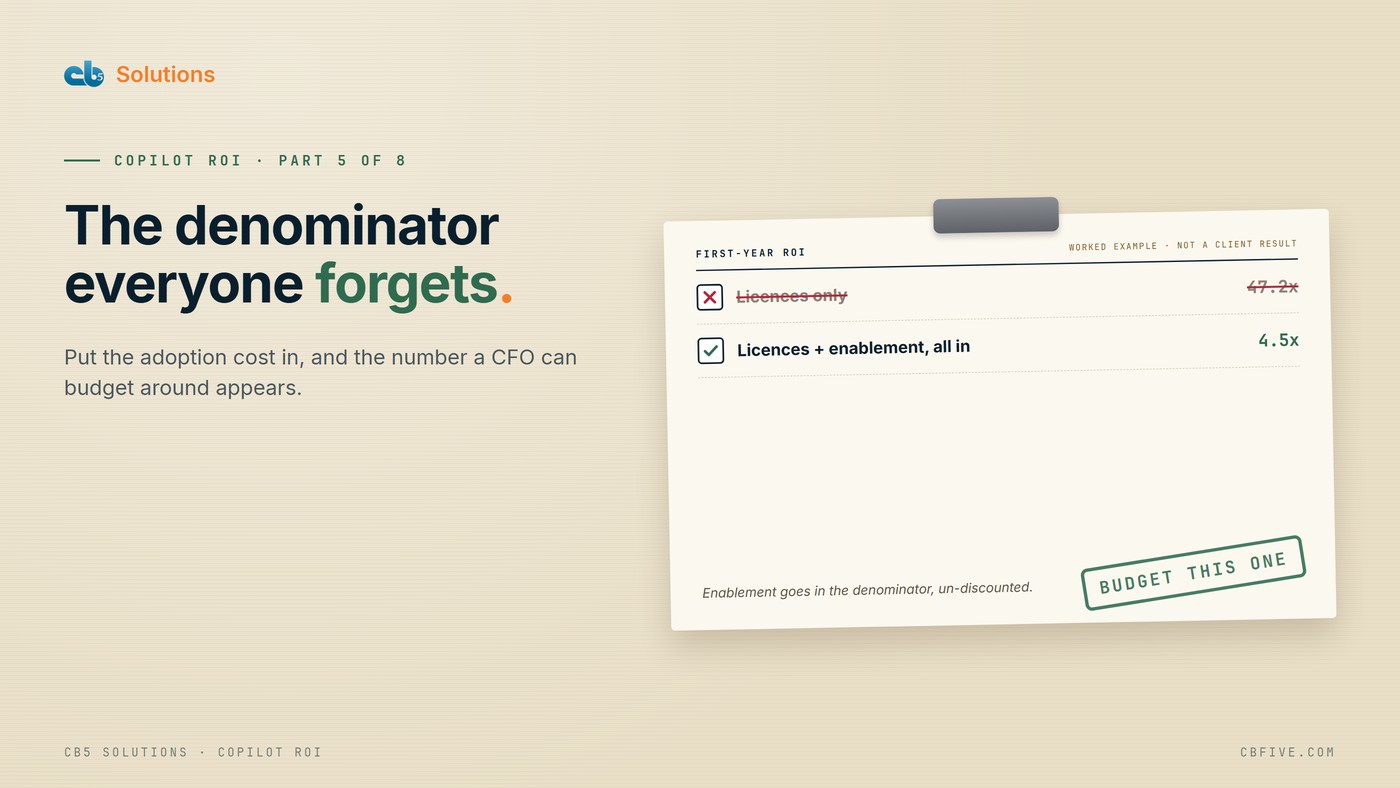
A CFO approving a Copilot rollout already knows the question: what will year one actually cost, and when does it pay back? The usual answer is the licence, per user per month, times the seats. That is the usual ROI denominator, and for year one it is the wrong one, because it leaves out the cost that decides whether the rollout pays off: getting people to use it.
Training time, and the slower weeks before the habit forms, are a real investment that lands in year one. Leaving it out is the biggest reason first-year Copilot ROI looks better on paper than the first year feels.
This is the fourth correction in the series, and it moves the number the most.
The symptom: a first-year return that ignores the first year’s real cost
The licences-only view is clean: value over licence spend, one big multiple. In our worked example, that first-year figure is 47.2 times licence cost.
But nobody’s first year costs only the licence. Every licensed user spends time in formal training and far more in informal discovery: asking a colleague, retrying a prompt. That time has a value, at the same loaded rate used to count the hours saved, and it is spent whether or not anyone budgets for it. A denominator that ignores it answers a question nobody asked: what would the return be if adoption were free? Adoption is never free.
The licences-only multiple isn’t a lie. It answers the wrong question, and the right question costs more.
What we assumed — and the mistake we made counting it
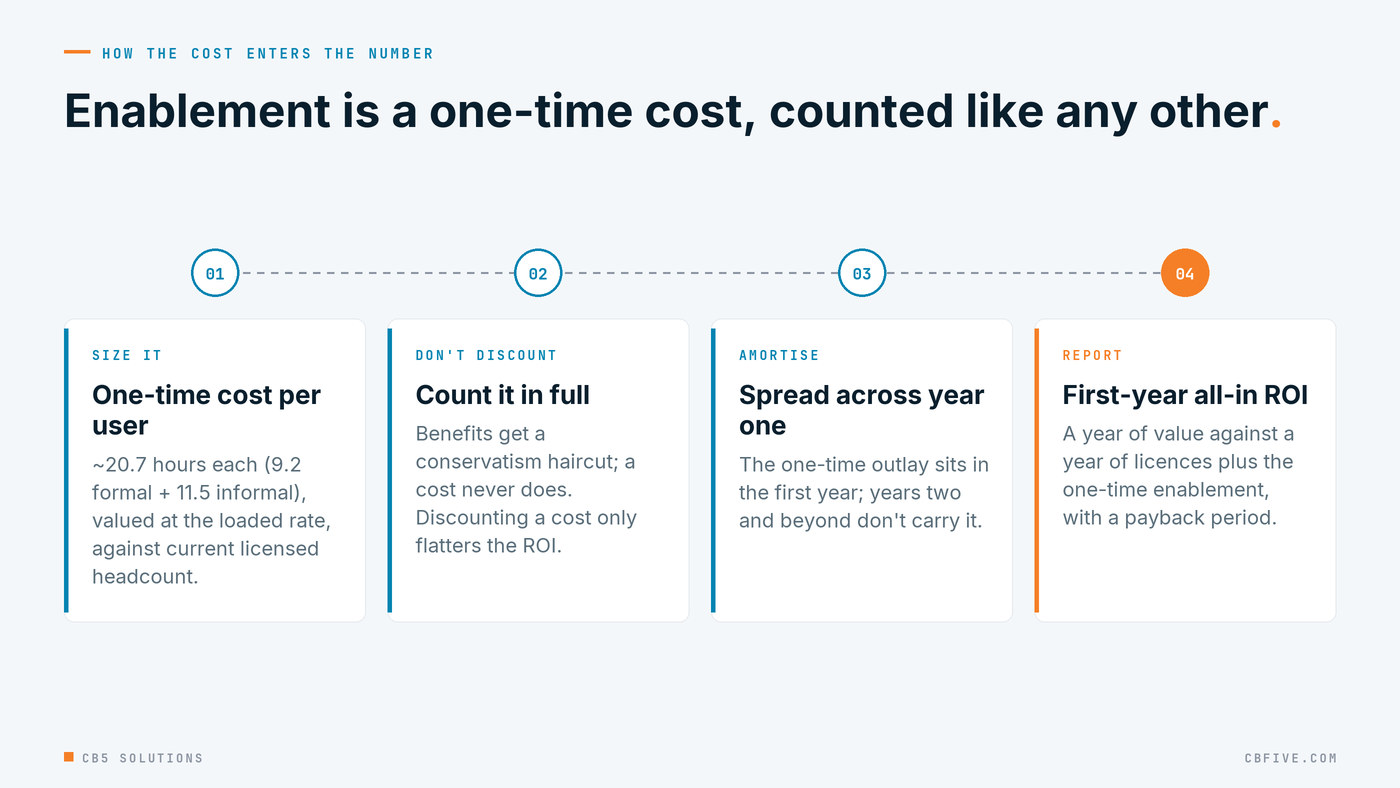
Our first instinct was the common one: licence cost is the cost. The program now models enablement as a one-time cost per licensed user: about 9.2 hours of formal training plus 11.5 hours of informal discovery, 20.7 hours each, valued at the loaded rate. Two rules keep it honest. First, it is costed against the current licensed headcount. We got this wrong at first, counting everyone licensed in the trailing 180 days, including people whose licences had since been removed. That overstated the cost by around 30% until a verification run caught it. Second, the enablement cost is not reduced by the conservatism factor applied elsewhere. Discounting a cost flatters the ROI, the opposite of conservative. You haircut benefits, never a cost.
The fix: a first-year all-in number, shown next to the steady-state one
With enablement counted, the program reports a first-year all-in figure: a year of value against a year of licence spend plus the one-time enablement, with a payback period attached.
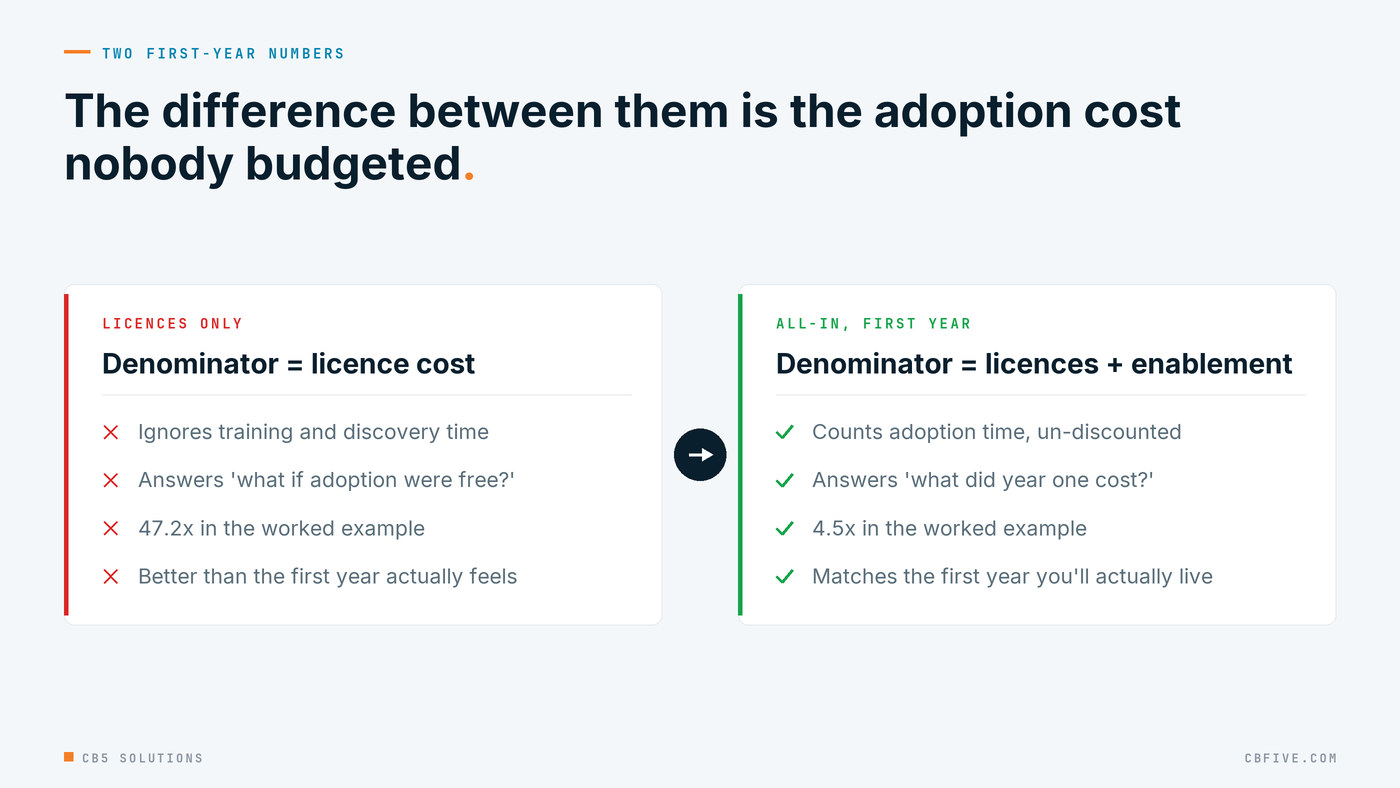
In the worked example, first-year ROI drops from 47.2x licences-only to 4.5x all-in. That gap is the enablement nobody budgeted for, made visible. The steady-state figure still has its place, because the one-time cost is genuinely one-time, so the program shows both, each labelled: all-in for the first year, steady-state after.
One more cost is disclosed rather than counted: metered agent spend. It isn’t in the usage data the program reads; it sits in the Copilot Credits report and Azure Cost Management, so the denominator is licence cost only, and the readout says so plainly. Where agent users are all licensed, metered spend is usually small, but it is stated, not hidden.

Why the all-in number is the one a CFO wants
A CFO has learned to distrust a 47.2x that ignores adoption cost, because they lived through the first year and know it wasn’t free. A 4.5x all-in, with the enablement line shown and a payback period attached, matches their experience. It is lower, and it is the one that gets funded.
Finance and department leaders own the question and the hurdle rate. What they usually lack is a defensible way to size enablement, or a cost line they can trace. IT and CB5 supply that: the method, a cost basis from current licensing data rather than a slide estimate, and a readout that says what it counts and what it doesn’t. The standard it proves is auditability: every line in the denominator traces back, and none of it is discounted to flatter the result.
Enablement isn’t a reason not to deploy; in the worked example the all-in return is still strongly positive. But it will be spent either way, so it belongs in the plan. Showing it up front gets the training budget approved alongside the licences, instead of discovered mid-rollout when adoption stalls.
The general rule: put enablement in the denominator, don’t discount it, and report first-year all-in ROI next to the steady-state figure. The all-in number is lower, it matches reality, and it is the one a CFO will budget around.
Next week: Compared to What? The Holdout and the Honest Negative. An all-in number answers “how much,” not “compared to what.” Part 6 covers the control group, and counting the hours Copilot costs as well as the ones it saves.
CB5 Solutions helps organizations understand the layers of AI, get the most from what they buy, and build an AI program that pays back inside their IT standards. We start every engagement with one business problem and a governance baseline. Let’s pick yours.