
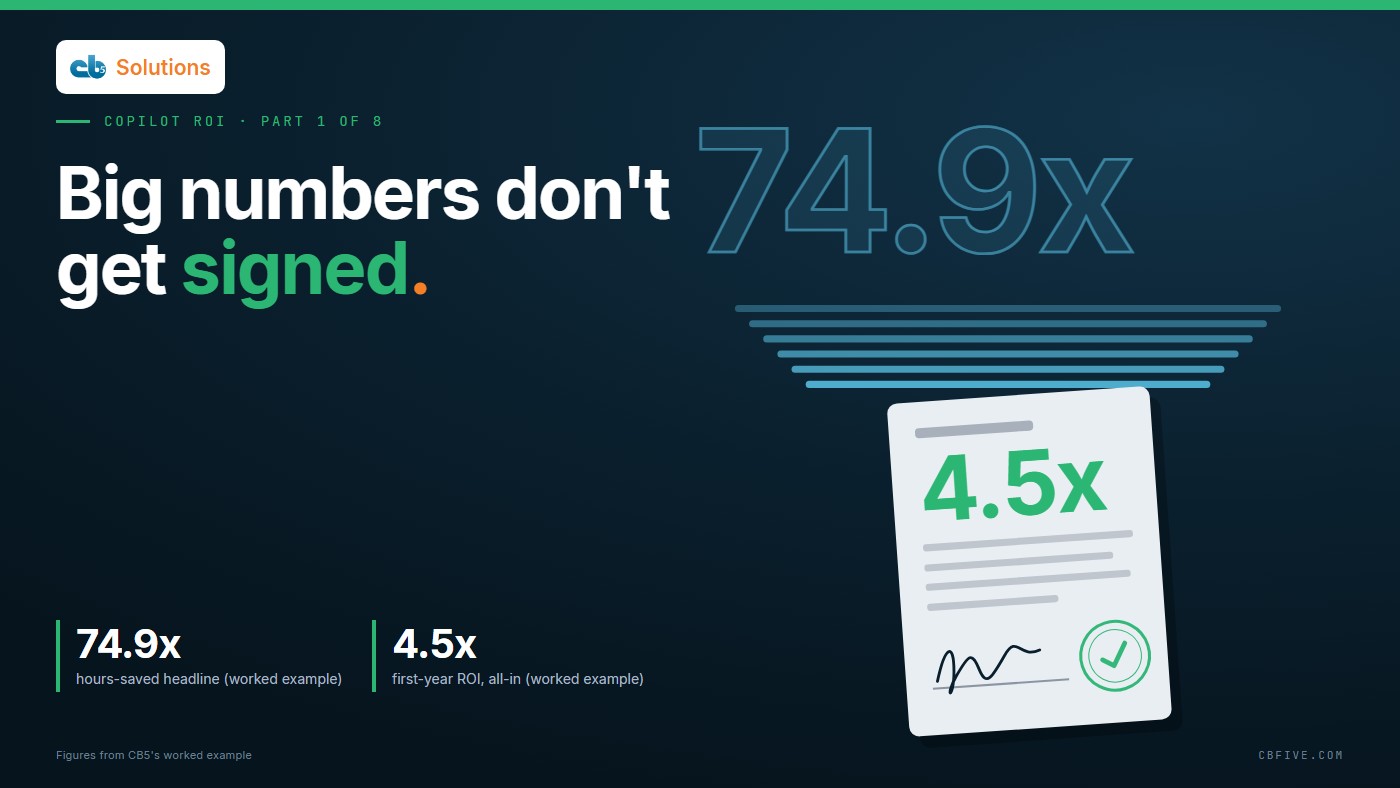
Your CFO already knows the question Copilot has to answer: what are we getting back for what we’re spending? What finance usually can’t see is how to measure that credibly, what the rollout really costs once enablement is counted, and whether the claimed savings are real. So the business case arrives with one big multiple: “Copilot is returning 75 times its licence cost.” It dies the moment finance asks the second question.
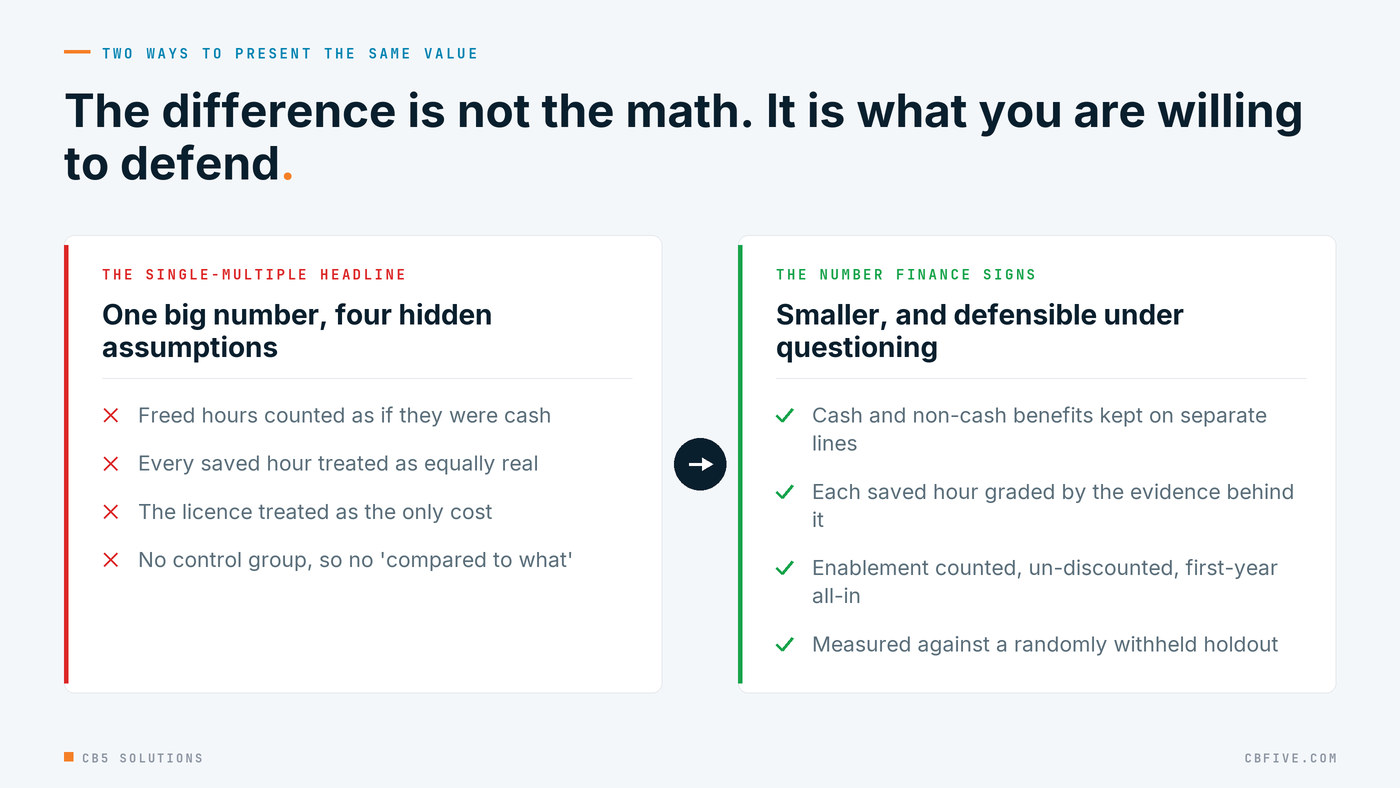
We’ve written that headline, and watched it fail. It rests on four quiet assumptions a finance reviewer takes apart in about ninety seconds: that freed hours are money, that every saved hour is equally real, that the only cost is the licence, and that nothing would have changed without the tool. Pull any one and the 75x is a number nobody will sign.
So we built a program that produces a smaller, defensible number that answers the second question before it’s asked. This is Part 1 of 8, written for IT and business leaders who have been told to “prove the ROI” and know how that meeting goes.
What the program actually is
It isn’t another usage dashboard. It’s a Power BI model and a PowerShell engine that read the tenant’s own Copilot telemetry and turn it into a monthly program: licensing decisions, the cheapest intervention for each struggling user, training, an executive readout, a governance runbook and a business case.
Dashboards tell you what happened; the program decides what to do about it. Its design posture is conservatism: it would rather report a smaller number it can defend than a larger one it can’t. Every correction in this series makes the headline smaller and the case stronger.
That’s the split we think matters. The business sets the standard of proof, the same one it applies to any other investment. IT and CB5 supply the method, the governance and the audit-grade data so the number meets it.
The six ways the headline lies, and how we fix each
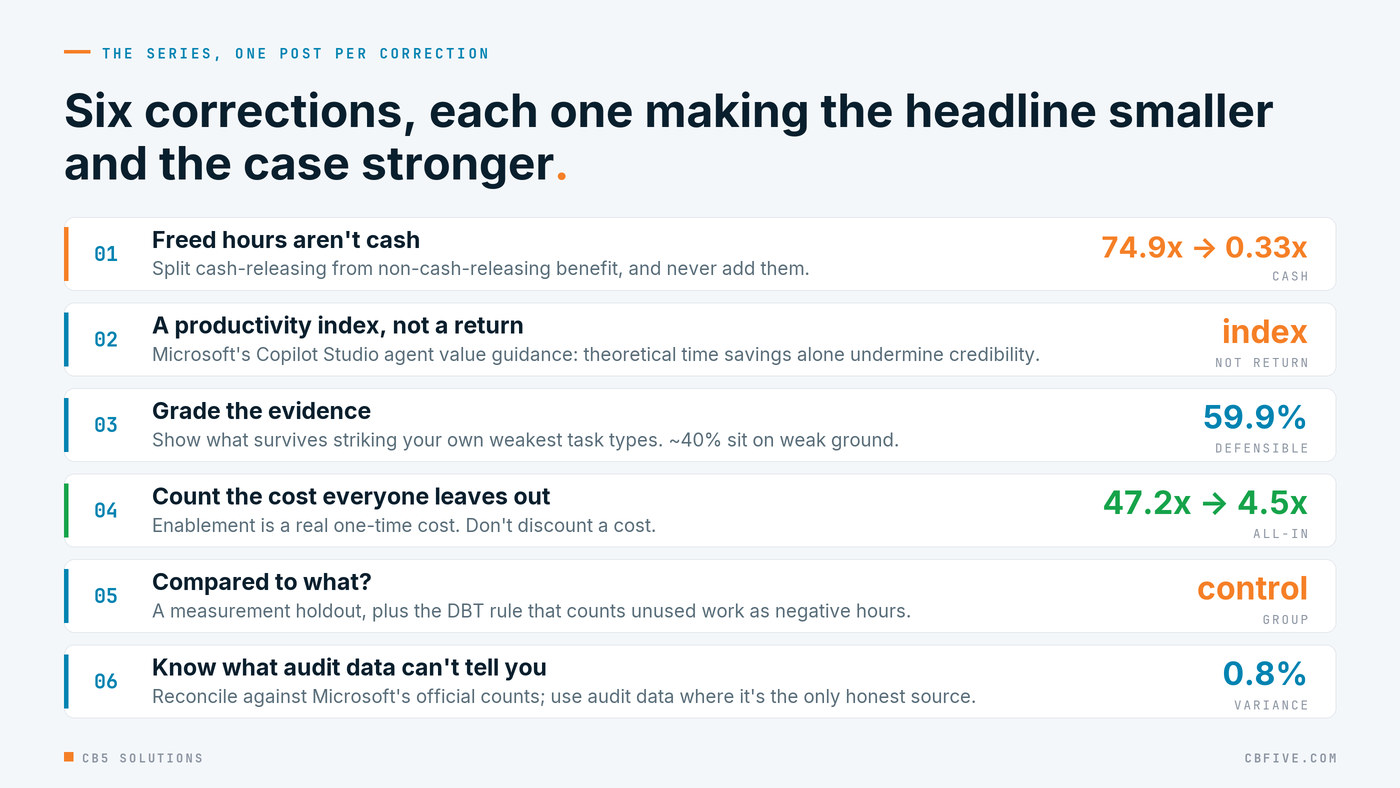
The honest number is six separate corrections, each answering an objection finance will raise. Here’s the whole arc, with figures from the model’s own worked example.
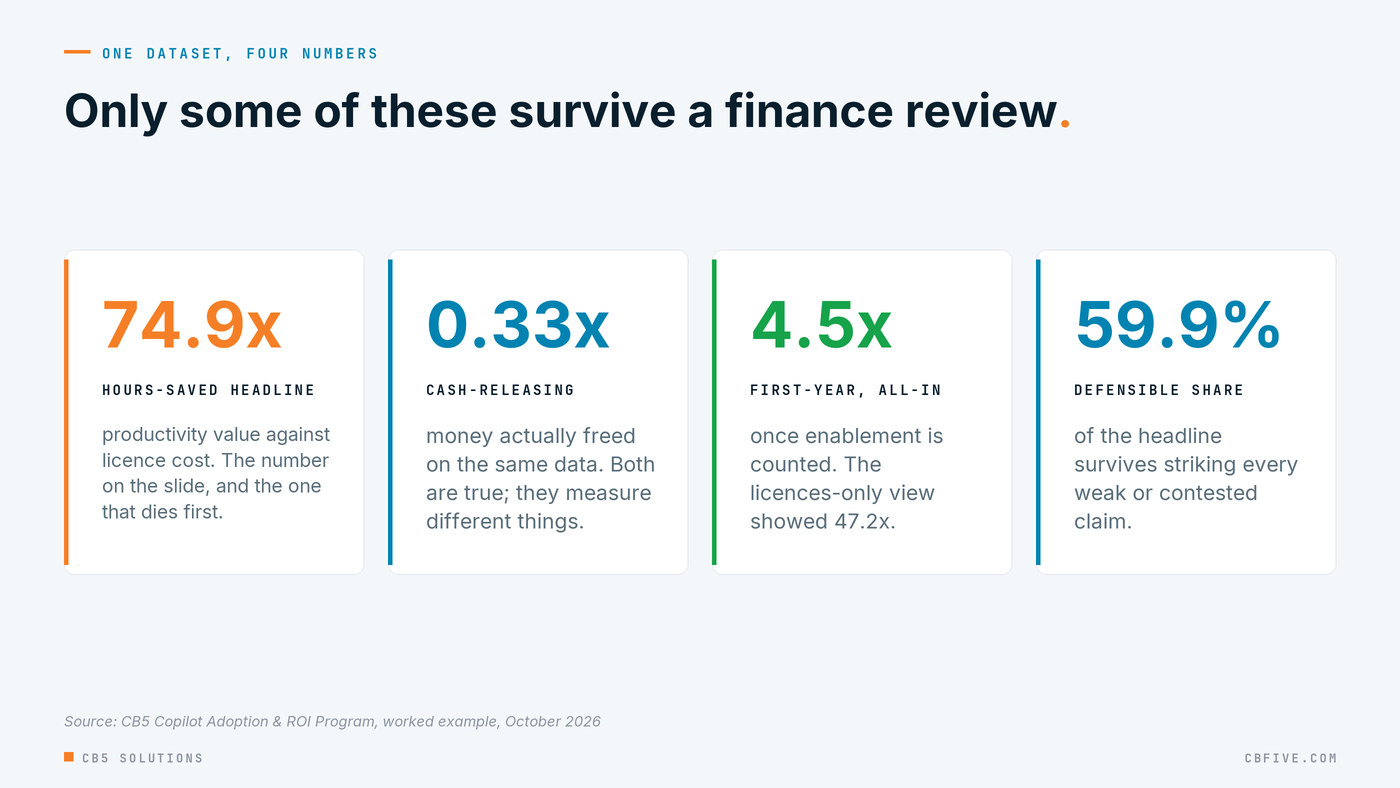
First, freed hours aren’t cash. An hour a rep gets back isn’t money until someone acts on it: a seat not bought, a backfill avoided. UK Treasury doctrine (the Green Book) distinguishes cash-releasing benefits, which “affect the income or expenditure of a public body”, from non-cash-releasing ones. Only cash-releasing benefits pay for anything, so we report them as separate lines and never let hours stand in for cash. In our worked example the productivity headline is 74.9x. The cash-releasing figure on the same data is 0.33x. Both are true, and summing them is how a business case gets laughed out of the room.
Second, call it a productivity index, not a return. Microsoft’s guidance on measuring the value of Copilot Studio agents says that “claiming value based on theoretical time savings alone undermines credibility.” So the program quotes that line on the page and shows cash-only ROI beside the hours-based index. A number is a return only when a budget line falls.
Third, grade the evidence. Time savings for chat drafting and summarisation are well supported by independent research; for slides and spreadsheet analysis, far less so. The program grades each task type, then shows the suppression view: strike every weak or contested claim and report what’s left. In the worked example the defensible headline is 59.9% of the gross one. Roughly 40% of the claimed hours sit on task types the evidence doesn’t strongly support.
Fourth, count the cost everyone leaves out. Training and discovery time is a real one-time investment, and leaving it out flatters the ratio. The program models it without discounting it. In the worked example, first-year ROI drops from 47.2x on a licences-only view to 4.5x all-in. The gap is the enablement nobody budgeted for.
Fifth, answer “compared to what?” The honest answer to the counterfactual is a control group: a measurement holdout of randomly withheld licences. The program supports one, flags contamination, and applies the UK Department for Business and Trade’s rule that work which went unused, or only happened because the tool existed, counts as negative hours. On a test diary, that rule matched the pattern in DBT’s own evaluation: scheduling came out net negative, slide decks netted to roughly zero, and Excel analysis, which DBT observed was slower and lower quality, showed little or no saving.
Sixth, know what your data can’t tell you. Microsoft states plainly that audit data is not a basis for usage reporting. So the program never reports its own usage count alone. It shows its figure, Microsoft’s official figure and the variance between them; in the worked example they reconcile to within 0.8%. The same honesty cuts the other way: for whole-estate agent inventory and sensitive-content exposure, audit data is the only source with complete coverage, and that’s where IT should rely on it.
Why smaller is the point
The big number was never the deliverable. The signature was. A 75x that collapses under one question costs you the room. A 4.5x all-in, or a productivity index shown next to a real cash figure, keeps you in it.
Because the corrections are separate, the program also shows where a case is weak before finance does. If your defensible headline still clears the hurdle after you’ve struck your weakest claims, counted enablement and set aside the non-cash hours, you have a case you can take anywhere. If not, you learn that in a working session, not in front of the CFO.
What this series covers
One post to frame the problem, six corrections, and a final post where we turn the method on our own tool. Each correction post ends with a rule you can apply whether or not you use our tool.
- This post: why the single-multiple headline dies, and the six corrections.
- Freed hours aren’t cash: the cash vs non-cash split, and why you never add the two.
- The time-savings trap: a productivity index, not a return, and the five tests for a real conversion.
- Not all saved hours are equal: grading the evidence and reporting what survives striking your weakest claims.
- The cost everyone leaves out: enablement, and the first-year all-in number a CFO budgets around.
- Compared to what?: the measurement holdout and the honest negative.
- What audit data can and can’t tell you: reconciling usage counts, and where audit data is the only honest source.
- We built a Copilot ROI tool, then tried to break it: the same scrutiny, applied to ourselves.
The rule for the whole series: make the number smaller on purpose, until what’s left is the part you can defend. That’s the number worth taking to the CFO, and it’s the one that comes back signed.
Next week: Freed hours aren’t cash, and the split that saves the business case.
CB5 Solutions helps organizations understand the layers of AI, get the most from what they buy, and build an AI program that pays back inside their IT standards. We start every engagement with one business problem and a governance baseline. Let’s pick yours.