
One of the questions we get asked most is “where should we start with AI?” When a leadership team sits down to answer it, the list usually starts with the exciting ideas: a chatbot that answers members around the clock, an agent that approves loans, a tool that predicts which customers are about to leave. They’re easy to picture, and they go over well in a strategy meeting.
We think they’re also the hardest projects to start with. Each one faces customers, leans on judgment calls, and costs a lot when the answer’s wrong. Meanwhile, the work that would pay back fastest gets ignored. Someone writes the same monthly commentary for the fortieth time, the help desk answers the same password question all morning, and a manager digs through a policy binder for an answer they looked up last week. Nobody puts that work on a slide, and that’s a big part of why we like it as a place to start.
In part five we looked at whether a problem needs AI at all. In this post we want to cover the next decision: of the problems that do, which three should go first?
Why Boring Wins
We’ve found the best first AI targets have five things in common. The work is repetitive, so the AI sees the same shape of task every time. It’s high-frequency, so small gains add up every week. It’s low-judgment, so a draft that’s 90% right is still useful and a person can easily fix the rest. It’s high-return, because the hours involved are real and you can count them. And it has a single owner, one leader who can change how the work gets done and who’ll be held to the result.
The research lines up with this. Stanford HAI’s AI Index 2026 finds task-level productivity gains of about 14–15% in customer support and 26% in software development, with smaller gains on work that depends on deep judgment. In other words, AI helps most where the work is structured and repeated.
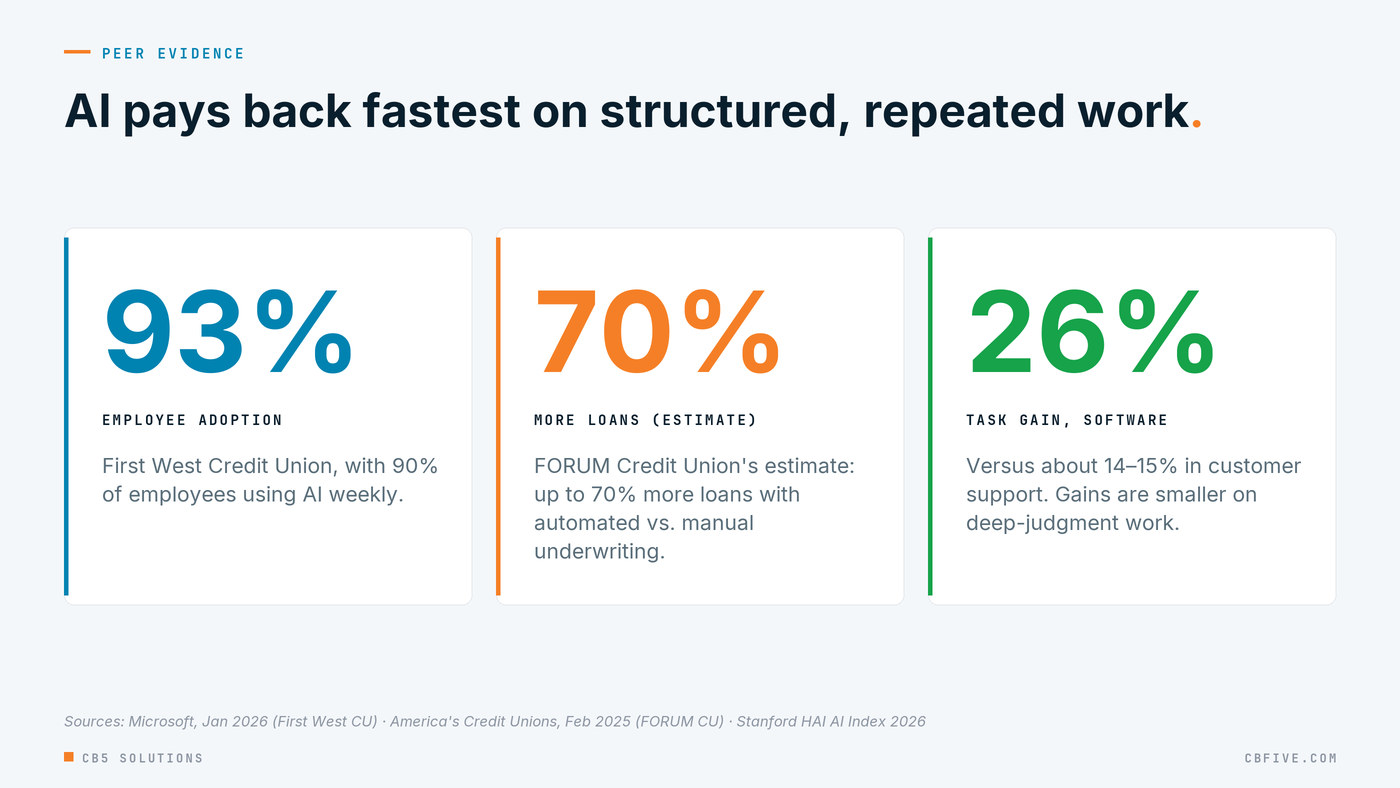
Sources: Microsoft, January 2026 (First West Credit Union) · America’s Credit Unions, Feb 2025 (FORUM Credit Union) · Stanford HAI AI Index 2026.
Financial-services peers show the same pattern. Microsoft reported in January 2026 that First West Credit Union reached 93% employee adoption and 90% weekly use. Our take is that kind of daily use comes from AI being part of ordinary, everyday work rather than from one headline project. FORUM Credit Union told America’s Credit Unions in February 2025 that it estimates automated underwriting lets it process up to 70% more loans than manual underwriting, or in its COO’s words, “doing more with the same number of people.”
What to Leave for Later
Some work doesn’t belong in the first wave. It’s not that it isn’t valuable. The first wave has a different job, which is building trust, skills and a track record.
Flashy work. If a use case was picked because it’ll impress people, its real measure of success usually ends up being the demo instead of the result.
Member-facing and customer-facing work. A wrong answer given to a member turns into a complaint, a correction and sometimes a regulatory problem. We’d start where a staff member looks over the output before anyone outside sees it.
Deep-judgment work. Credit decisions, investigations and hard exceptions are where AI helps least and a mistake costs most. AI can prepare the file, but it shouldn’t be the first thing you trust to decide. We’ll get into that pattern tomorrow, in part seven.
Where to Look
Across the financial institutions and mid-size companies we work with, the same kinds of workflows keep coming up. We see them almost everywhere. Your list will be a bit different in the details, but it’ll probably look a lot like this one.
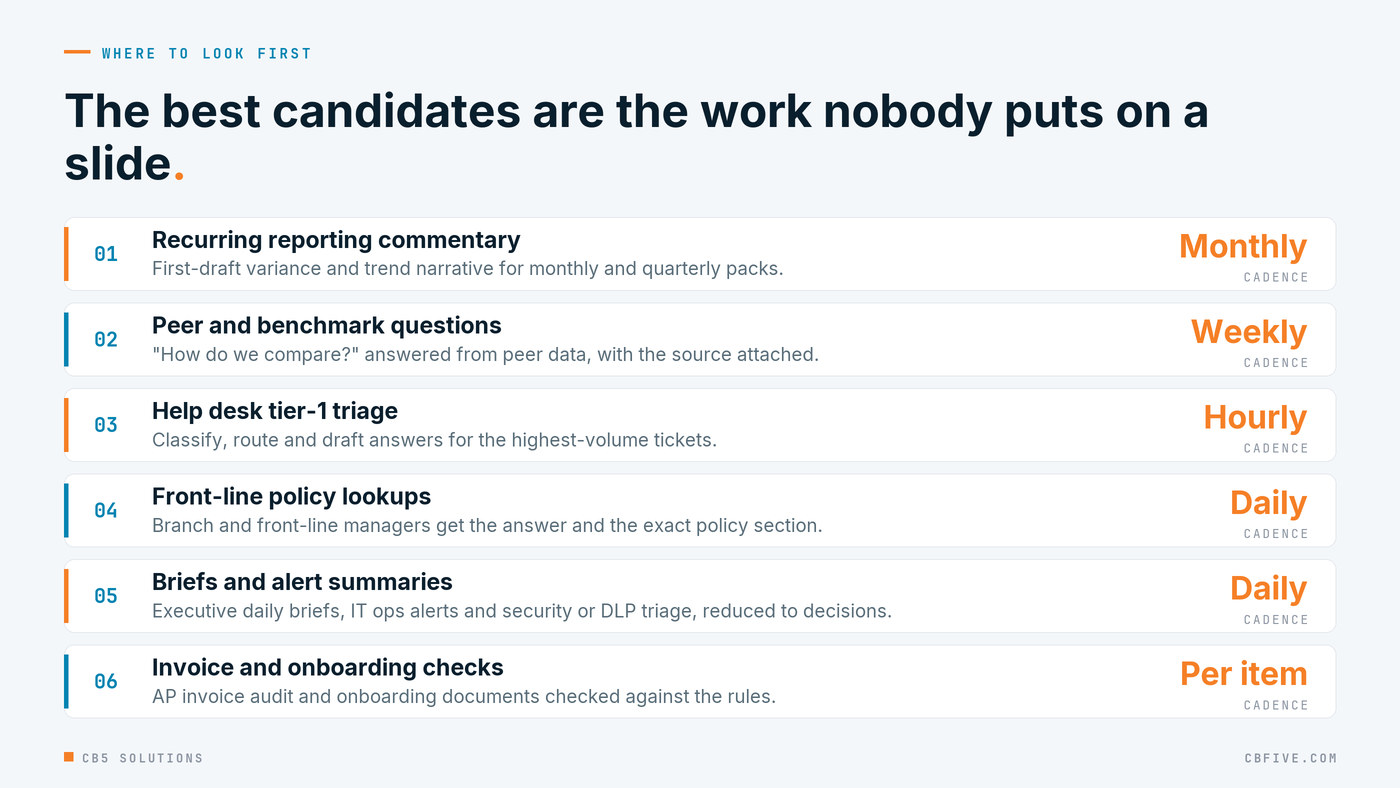
Recurring reporting commentary. First-draft variance and trend narrative for monthly and quarterly reporting packs. The numbers already exist, and it’s the writing that takes the time.
Peer and benchmark analysis questions. “How do we compare on deposit growth?” gets asked every quarter and answered by hand every time.
Help desk tier-1 triage. Sort, route and draft responses for the tickets that make up most of the volume. Ask anyone who’s worked on the infrastructure side: this one is a fair bit of the day for most IT teams.
Branch and front-line manager policy lookups. Give the answer and point to the exact policy section it came from, so the manager can check it in seconds.
Executive daily briefs, IT ops alert summaries and security or DLP alert triage. Each one turns a pile of information into a short list of things someone has to decide, and a person still decides.
Invoice and AP audit, and new-member or customer onboarding document checks. This is checklist work: does this document meet these rules? Flag the exceptions for a person to review.
Score Every Candidate on Six Questions
To narrow the list down, score each candidate from 1 to 5 on six questions. It takes about an hour with the people who actually do the work.
- Frequency. How often does this happen: hourly, daily or monthly?
- Volume. How many people-hours does it eat up across the organization?
- Rule-boundedness. Could you write down most of the rules a good employee follows?
- Data readiness. Is the input data available, accurate, and permissioned correctly for AI to see? (Part four covers why this one matters most.)
- Owner. Is there one named business leader who’ll change the process and report on the outcome? The people who do the work know where the time goes, so the business should drive the pick. IT’s job is the guardrails around it.
- Risk of a wrong answer. If the AI gets it wrong, does a person catch it, or does it reach a member, a regulator or the general ledger? Score low risk as high.

The total’s out of 30. Honestly, the exact numbers matter less than the conversation they force. A low score on owner or data readiness is the most useful thing you can find out, because it tells you what to fix before you spend anything. The scores above are only an example, and yours will depend on your data, your people and your processes.
Plot Value Against Effort
Scores tell you which candidates are good fits, but they don’t tell you the order. For that, we like to put each candidate on two axes: the value it’d return, and the effort it’d take to deliver. Effort means data cleanup, permission fixes, integration and change management, not just licenses. It also depends on which layer of the platform the work needs. A drafting task may run on the Copilot you already pay for, while a multi-step workflow may need Copilot Studio. Matching the layer to the problem is where a lot of the money is.
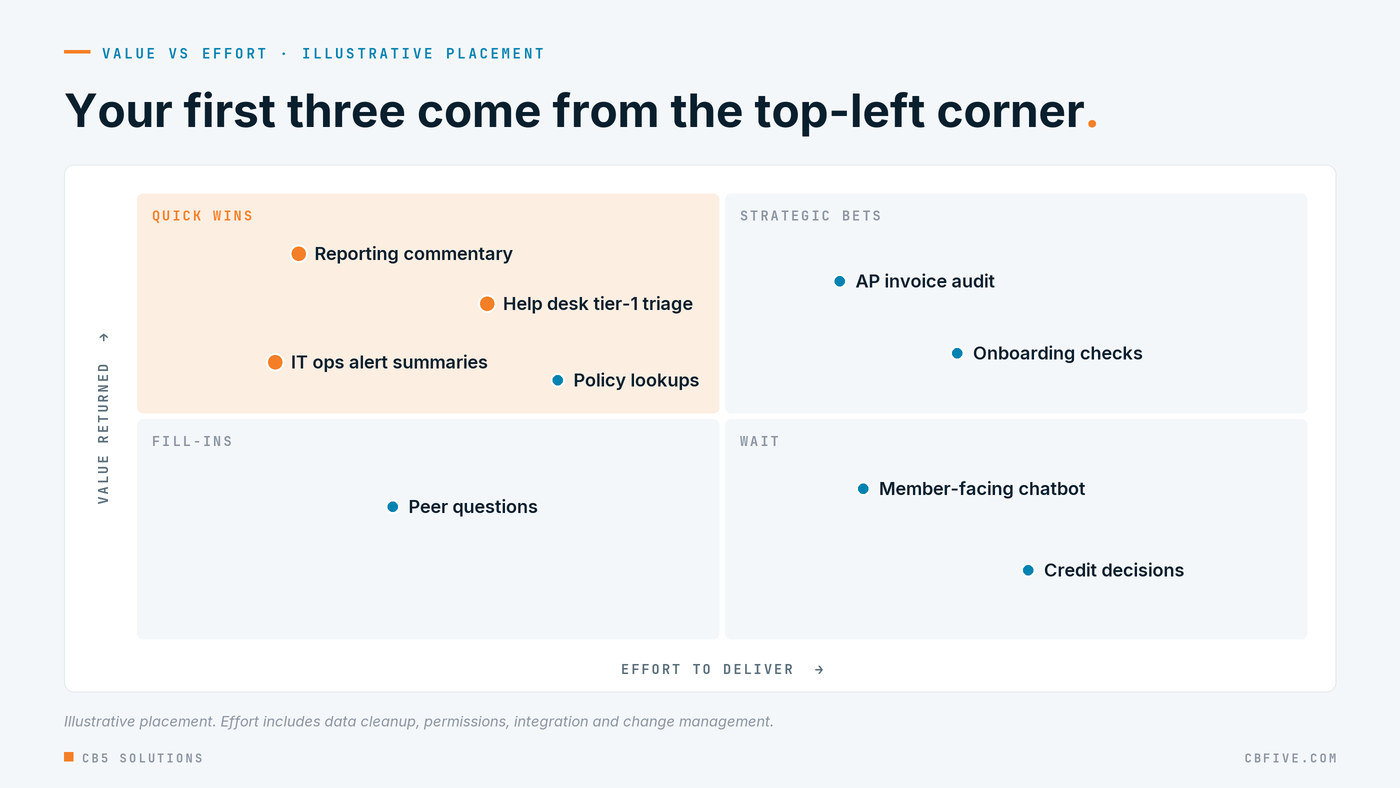
Quick wins (high value, low effort) are your first wave. Strategic bets (high value, high effort) go on the roadmap, and the first wave helps pay for them and teaches you how to do them. Fill-ins are worth doing once the habit’s in place. Anything in the last quadrant waits.
Picking Your Three
Pick three candidates from the quick-win quadrant, and make sure they come from different teams, say one in finance, one in IT and one in operations. Three is enough to show a pattern without spreading yourself thin. Spreading them across teams builds champions in more than one place, and it keeps one success, or one failure, from defining the whole program. Give each one a business owner, an outcome measure that isn’t usage, and a decision date. Before any of them goes live, have IT set the baseline: who can see what data, how outputs are logged for audit, and what the tool is not allowed to do.
Getting Started
- List every candidate you can think of in one session, with the people who do the work in the room, not just their managers.
- Score each one on the six questions, and write down why it scored low anywhere it did.
- Plot the survivors on value versus effort, and be honest about how much data cleanup is involved.
- Pick three quick wins owned by different teams, each with one named owner and one outcome measure.
- Set a 60-to-90-day decision date for each one: scale it, fix it or stop it.
Talk to Us
CB5 Solutions helps organizations understand the layers of AI, get the most from what they buy, and build an AI program that pays back inside their IT standards. We start every engagement with one business problem and a governance baseline. Let’s pick yours.
Tomorrow: AI Prepares, a Human Decides: The Pattern Behind Agents That Survive an Audit.