

The CFO already knows the question to ask about any Copilot business case: which budget line went down? Hours saved, multiplied by a loaded rate, make a number with a lot of zeros, but no budget line moved. The question is fair. The number isn’t fake, but it isn’t money either, and presenting it as if it were is how a business case loses the room.
This is the first of the six corrections from the series opener, and it has the oldest fix. Government finance has drawn this line for years. The split between money freed and time freed has a name and a doctrine, and we add one rule of our own: never add the two together.
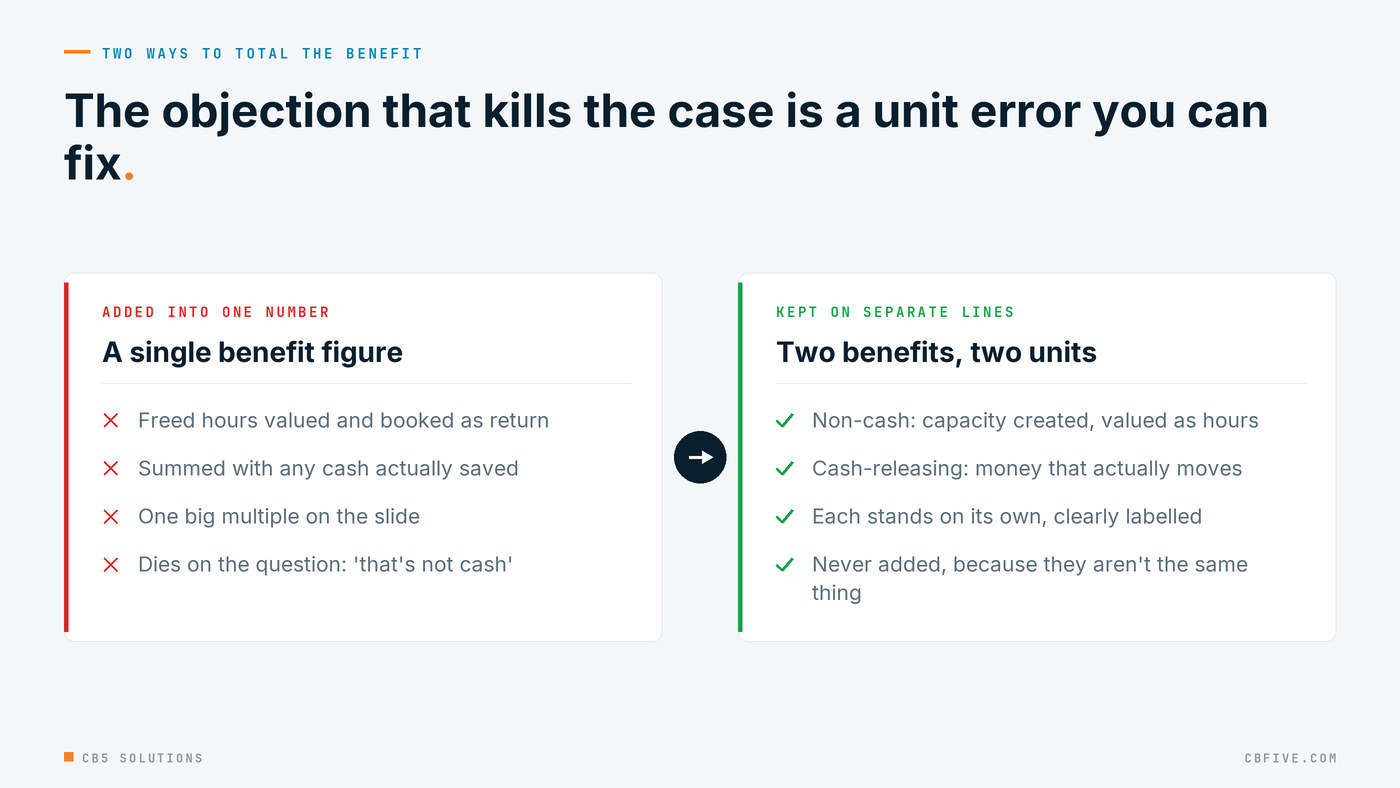
The symptom: one big number that assumes time is money
The default Copilot ROI calculation takes freed hours, values them at an hourly rate, and reports the result as the return. In our worked example, that produces a headline of 74.9 times licence cost.
The trouble is what the multiplication quietly claims. Valuing an hour at, say, $72 and booking it as return assumes that hour converts to $72 of cash: a backfill avoided, a contractor not hired. Sometimes it does. Often it doesn’t. The rep who saves forty minutes on a quote spends them on other work, and no budget line moves. The value is real as capacity. It isn’t real as cash, and a finance reviewer knows the difference on sight.
The headline isn’t wrong about the hours. It’s wrong about what kind of benefit they are.
What we assumed, and what finance doctrine actually says
When we first built the ROI model, we did what everyone does: one benefit number, hours times rate, against licence cost. It demos well, and it doesn’t survive contact with a finance function.
The fix came from how public-sector business cases have been written for years. The UK Treasury’s Green Book, which governs how government appraises spending, draws a hard line between two kinds of benefit. Cash-releasing benefits, which “affect the income or expenditure of a public body”, free actual money: a licence you no longer buy, a seat you reassign instead of purchasing, a contract you can cut. Non-cash-releasing benefits free something of value that isn’t money yet: capacity, hours, attention. Both are legitimate, but only cash-releasing benefits pay for anything, so we report them as separate lines and never let hours stand in for cash. We go one step further than the doctrine requires and never add the two into a single figure, because they aren’t the same unit.
Public-sector benefits guidance, such as the College of Policing’s, puts “improved productivity or time savings” squarely in the non-cash column. It’s the exact distinction a CFO is making with “that’s not cash,” and the objection lands because the standard Copilot headline has quietly summed the two.
The fix: two lines, labelled, never summed
So the program reports two numbers, and it never adds them.
The non-cash-releasing figure is the productivity value: the hours Copilot gives back, valued at the loaded rate. In the worked example, that’s the 74.9x. It belongs in the case, labelled as capacity, not cash.
The cash-releasing figure is built only from money that actually moves: unused licences reclaimed rather than renewed, and demand met by reassigning an existing seat instead of buying a new one. On the same figures, that comes to 0.33 times licence cost. It’s smaller by two orders of magnitude, and entirely defensible, because every dollar in it is a dollar that doesn’t leave the building.
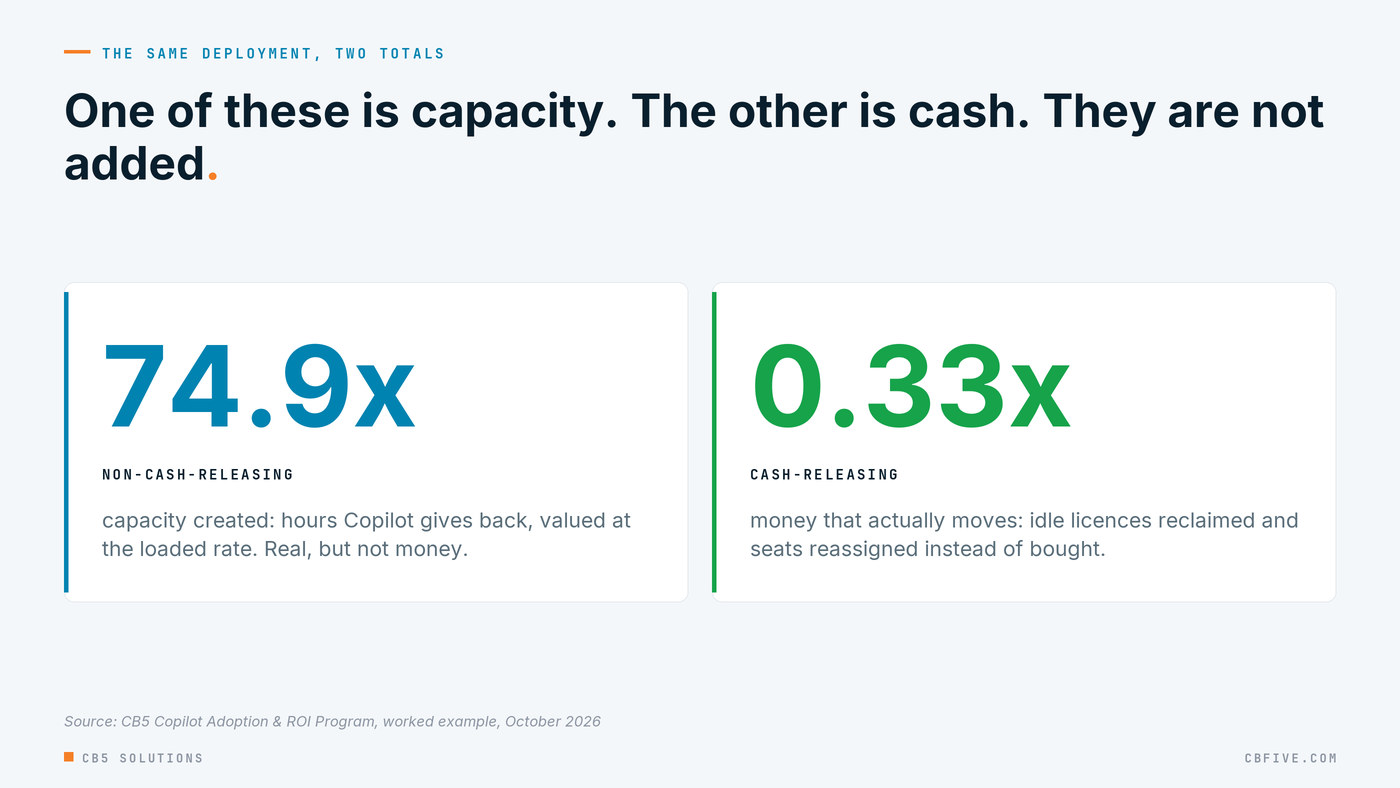
Seeing 0.33x next to 74.9x is uncomfortable the first time, but it says something true: this deployment is producing a lot of capacity and very little freed cash. That’s the normal early state of a Copilot rollout, and naming it opens the next conversation, about whether to convert some of that capacity into cash by consolidating licences, or to reinvest it in growth without adding headcount.
The program holds this line where it’s tempting to break it. Corroborating figures from Viva or Microsoft’s own dashboard are never added to the headline; they sit beside it as a second opinion. And a measurement holdout, when one exists, is excluded from the benefit population, so the capacity number isn’t inflated by the people serving as the control.
That’s the standard this illustrates. Finance sets the bar for what counts as cash; the business doesn’t need to be told that. What it usually lacks is a method that keeps the units apart and data it can audit back to the tenant. That’s the part IT and CB5 supply, so the number holds up to the business’s own rules.
Why the smaller number is the stronger one
The instinct is that 0.33x is bad news and 74.9x is the story. It’s the reverse. The 74.9x presented alone invites exactly one question, and the meeting is lost on it. The two numbers together answer that question before it’s asked, and they show a CFO someone who understands the difference between capacity and cash. That’s who gets funded.
Once the cash-releasing line exists, it becomes a lever. Reclaim idle licences and the cash figure rises. Reassign seats to people who’ve shown they’ll use them, instead of buying new ones, and it rises again. The program’s tipping-point and licensing decisions are built to move that specific number, so a CFO sees not just where cash-releasing value sits today, but the actions that would increase it next quarter.
The general rule: show both the capacity you’ve created and the cash you’ve freed, label which is which, and never add them. The honest total is two numbers, not one, and the two-number version is the one that gets signed.
Next week: why we stopped calling the hours multiple a “return” at all, and what we call it instead.
CB5 Solutions helps organizations understand the layers of AI, get the most from what they buy, and build an AI program that pays back inside their IT standards. We start every engagement with one business problem and a governance baseline. Let’s pick yours.