
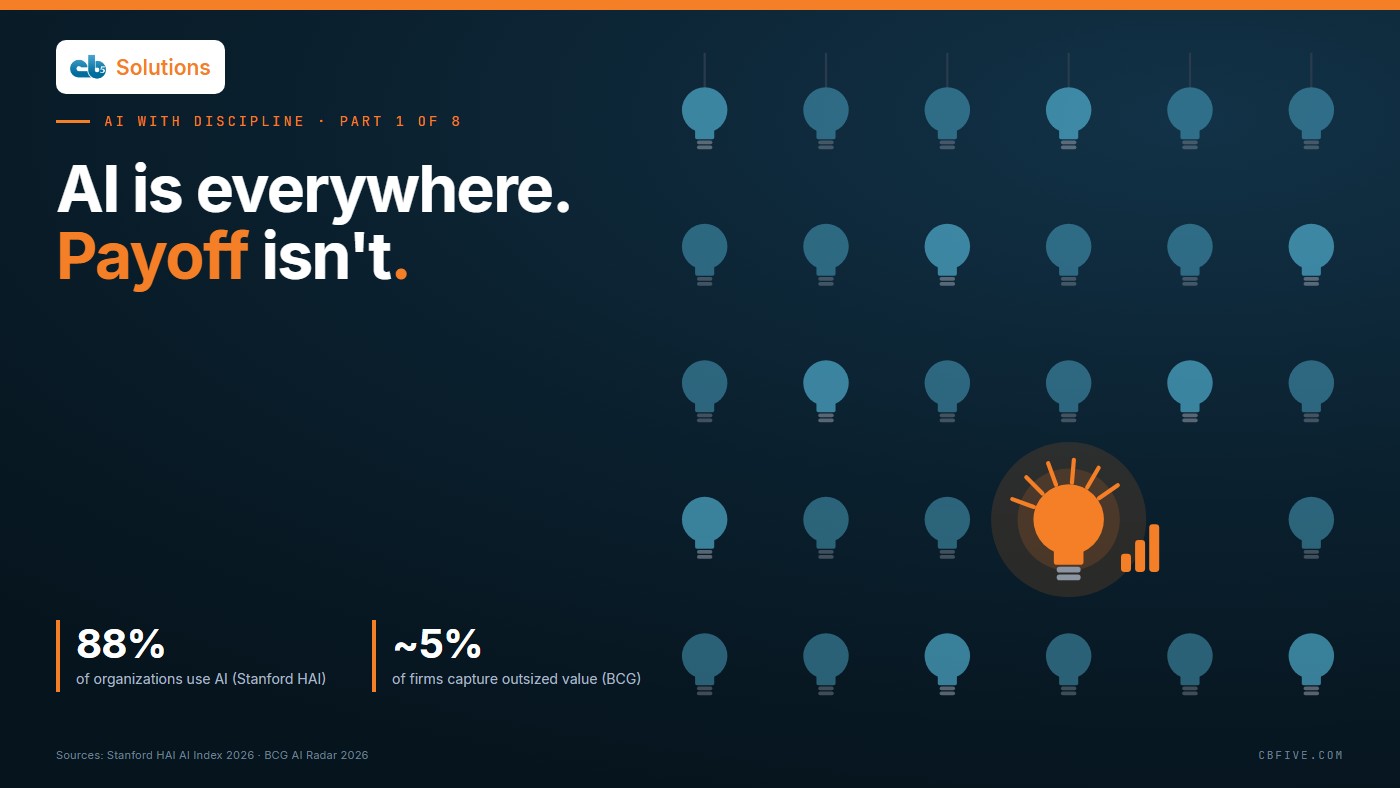
We wanted to write this series because of a question we keep running into with just about every leadership team we sit down with. They’ve already “done AI.” The licenses are bought, a pilot or two has run, and there’s probably a slide in the strategy deck with the word agentic on it. By any adoption measure, they’re on board. Then someone asks what has it actually changed?, and the room gets quiet.
We’ve seen plenty of Microsoft 365 rollouts land this way. Nobody can point to a process that runs differently, a backfill they didn’t need, or a cost line that bent. The AI is there but the value isn’t, and we think that gap between having AI and getting paid for it is the biggest problem in enterprise technology right now. We also don’t think it’s a technology problem.
This post kicks off an eight-part series on closing that gap. One idea runs through all of it: AI creates value when it is applied with discipline, not when it is pursued as a trend.
The 2026 Scorecard: Everyone Adopts, Few Profit
Let’s start with this year’s research, which tells a pretty consistent story.
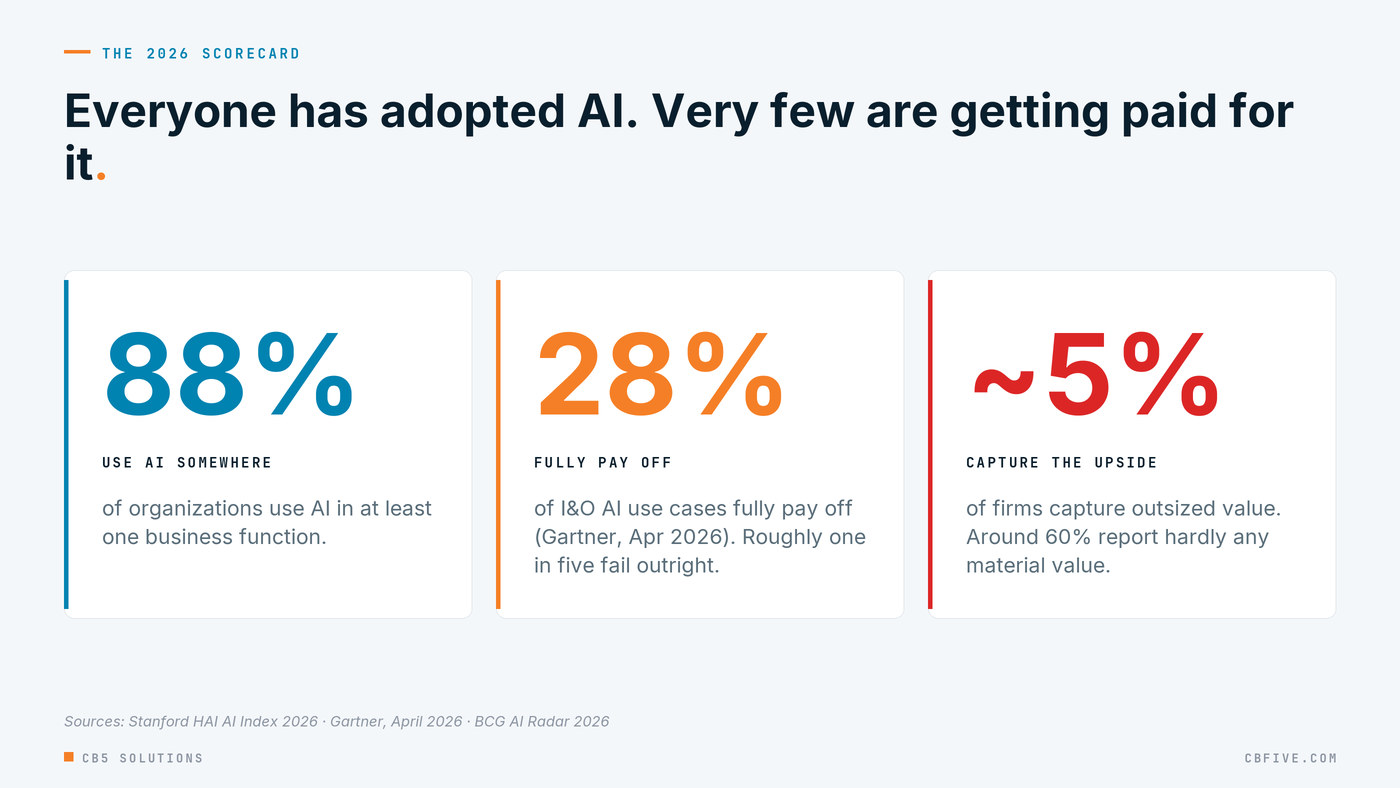
Sources: Stanford HAI AI Index 2026; Gartner, April 2026; BCG AI Radar 2026.
Stanford’s 2026 AI Index puts AI use at 88% of organizations in at least one function, so adoption is basically universal. But a Gartner survey of IT infrastructure and operations leaders this spring found only 28% of AI use cases in that area fully succeed and meet ROI expectations, and roughly one in five fail outright. BCG’s 2026 AI Radar is starker still: around 5% of firms capture outsized value, while about 60% report hardly any real value despite the spend.
When you put those together, the conclusion is a bit uncomfortable. Having the technology doesn’t set you apart anymore, because your competitors have the same models, the same Copilot licenses and the same vendor roadmaps you do. With that said, from what we’ve seen, what separates the 5% from the 60% is how the work gets chosen, governed and measured, and you control all of those.
What “Pursued as a Trend” Looks Like
We’ve found that trend-driven AI programs are pretty easy to spot, because they all start in the same place, which is the tool.
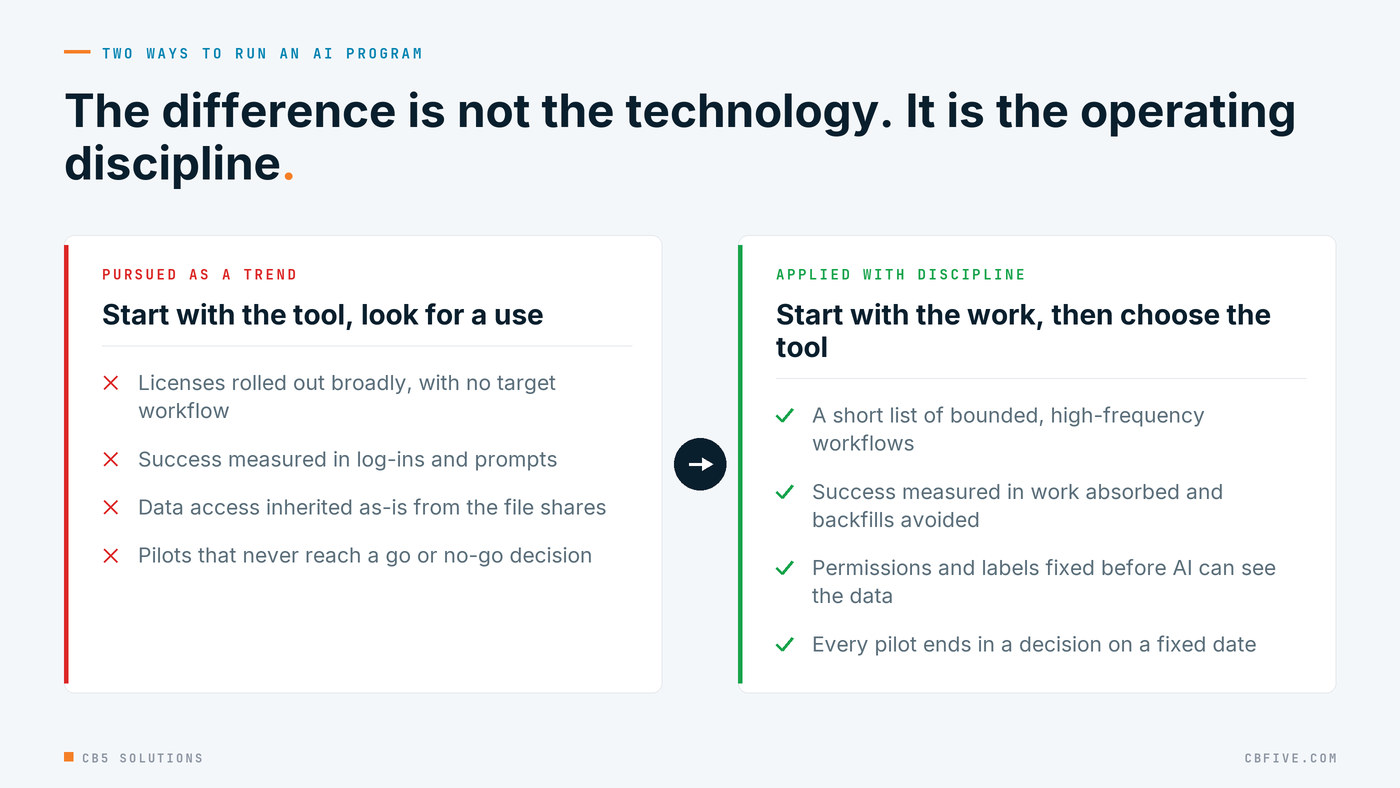
Licenses go out broadly, with no target workflow. Usually it’s one tier for everyone, bought before anyone matched a layer of the platform to a real problem. The thinking is that people will find the value on their own. A few enthusiasts do. Most try it twice, get a generic answer, and go back to how they worked before.
Success is measured in activity. Log-ins, prompts sent, monthly active users. Those are easy to report, but they say almost nothing about whether the business is better off. A team can be keen, heavy users of AI and still need exactly as many people next year as it does today.
Data access is inherited as-is. AI assistants see what the user can see, so every overshared folder and stale permission becomes something a model can pull up in seconds. This is the one we worry about most. Trend-driven programs usually find it out after launch, in an awkward meeting.
Pilots never end. Without a defined outcome and a decision date, a pilot drifts into “we’re still evaluating.” It keeps eating budget and attention and never gets to a go or no-go.
None of this comes from bad intentions. It’s just what happens when the question is “how do we use AI?” instead of “which work should change?”
What “Applied With Discipline” Looks Like
The programs we see succeed turn that around. They start with the work and pick the tool second.
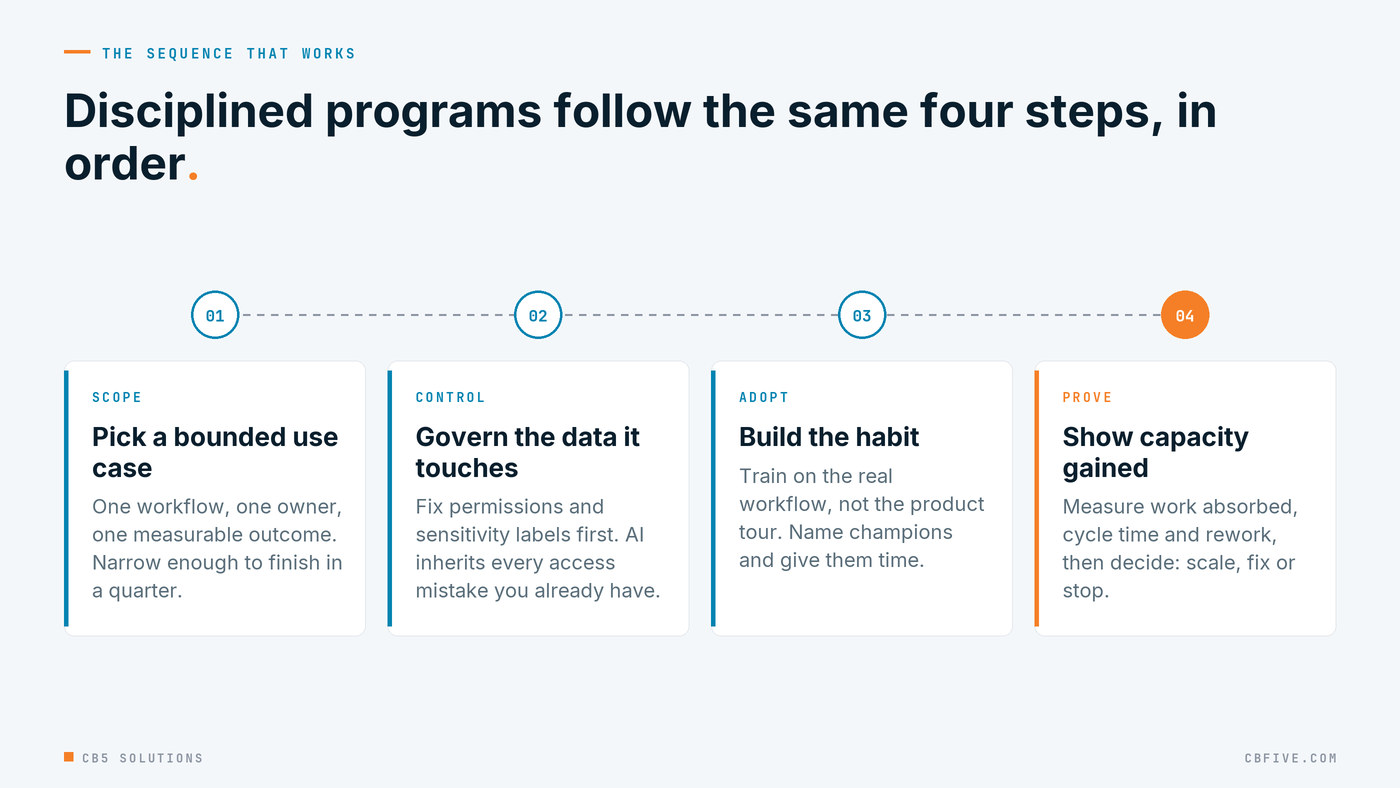
1. Scope a bounded use case. The business picks it, because the people who do the work know where the time and money go. One workflow, one accountable business owner, one outcome you can measure, and narrow enough to finish inside a quarter. “Use AI in operations” is too broad to be a use case, while “draft the first pass of the monthly variance commentary” is a good one.
2. Govern the data it touches. Before the AI can see anything, fix the permissions and sensitivity labels on the content in scope. This is IT’s part of the deal: security, compliance, governance and an audit trail, set up so the business can move without creating new risk. It’s rarely exciting work, but we’ve found it’s almost always the step that decides whether people trust the rollout. We’ll spend all of part four on it.
3. Build the habit. Train on the real workflow rather than a product tour. Name champions inside the team and give them time to help their peers. Expect adoption to take weeks of reinforcement, not one launch email.
4. Prove the capacity gained. Measure what changed in the work itself: volume absorbed, cycle time, rework, backfills avoided. Then make a clear call to scale it, fix it, or stop it.
The order matters a fair bit. If you jump to step four on a tool you handed out broadly, you end up measuring usage, because usage is the only thing there is to measure.
Redefining the Value: It Is Not Just “Time Back”
Most AI business cases we see are built on time saved, usually something like each employee gets back three hours a week. It’s an appealing number, and the research does back it up. BCG’s June 2026 AI at Work study found 42% of frontline employees who use AI regularly now save a full workday or more each week.
The same study also found that 66% of those employees get limited or no guidance on what to do with the freed time, and that’s where the business case quietly falls apart. Three hours spread across a week, with no change to how the work is organized, mostly disappears into email.
The executives we work with have started changing the goal. Rather than focusing on people getting time back, they’re asking whether the organization can absorb more work without proportional headcount growth. That looks like the same team handling more volume, a retirement or resignation you don’t have to backfill, or a new service line that launches without a new department to run it. We like this framing better. You can measure it, it shows up in the operating budget, and it’s the version of AI value a board will actually believe. Part two of this series is all about measuring it.

Where the Failures Actually Come From
When we look at AI initiatives that stalled, the cause is almost never the model. It’s usually one of four things: nobody owned the outcome, the process was broken before AI touched it, the data wasn’t ready to be exposed, or nobody agreed how to measure success. We run into those four over and over, and since they’re predictable, they’re also preventable. Part three walks through each one with real public examples.
Getting Started
If you’re somewhere between “we’ve bought the licenses” and “we can show what it changed,” here’s where we’d start:
- Write down the three workflows you’d most like to change. Look for ones that are repetitive, high-volume, and owned by one leader. If you can’t name three, that’s your first finding.
- Pick one outcome measure per workflow that isn’t usage, like cycle time, volume handled per person, rework rate, or backfills avoided.
- Audit permissions on the content those workflows touch before you widen AI access to it.
- Put a decision date on every pilot. Thirty to ninety days, then scale, fix, or stop.
- Ask the board-level question out loud: which work can we redesign so growth no longer requires proportional headcount growth?
Talk to Us
CB5 Solutions helps organizations understand the layers of AI, get the most from what they buy, and build an AI program that pays back inside their IT standards. We start every engagement with one business problem and a governance baseline. Let’s pick yours.
Next, later today: “Time Back” Is Not the ROI — how to measure work absorbed instead of minutes saved.