
The first half hour of the demo needed no project, no agent and no
SOW. That was the point of it.
Most organizations that own Microsoft 365 Copilot licences are using
a fraction of what’s in them. The adoption numbers we showed in the
roadmap session two months earlier were blunt about it: roughly a third
of licensed users have ever switched it on, and the organizations that
get real return are the ones where people use it every day in the apps
they already live in. So before we showed anything we’d built, we spent
twenty-eight minutes on what they’d already bought.
The trick was making those twenty-eight minutes about the seal
problem from post 1 rather than
about the apps. Here’s how each one went, what we planted for Copilot to
find, and the one honest line about licensing that we think every demo
owes its audience.
Teams: the chat you didn’t
read
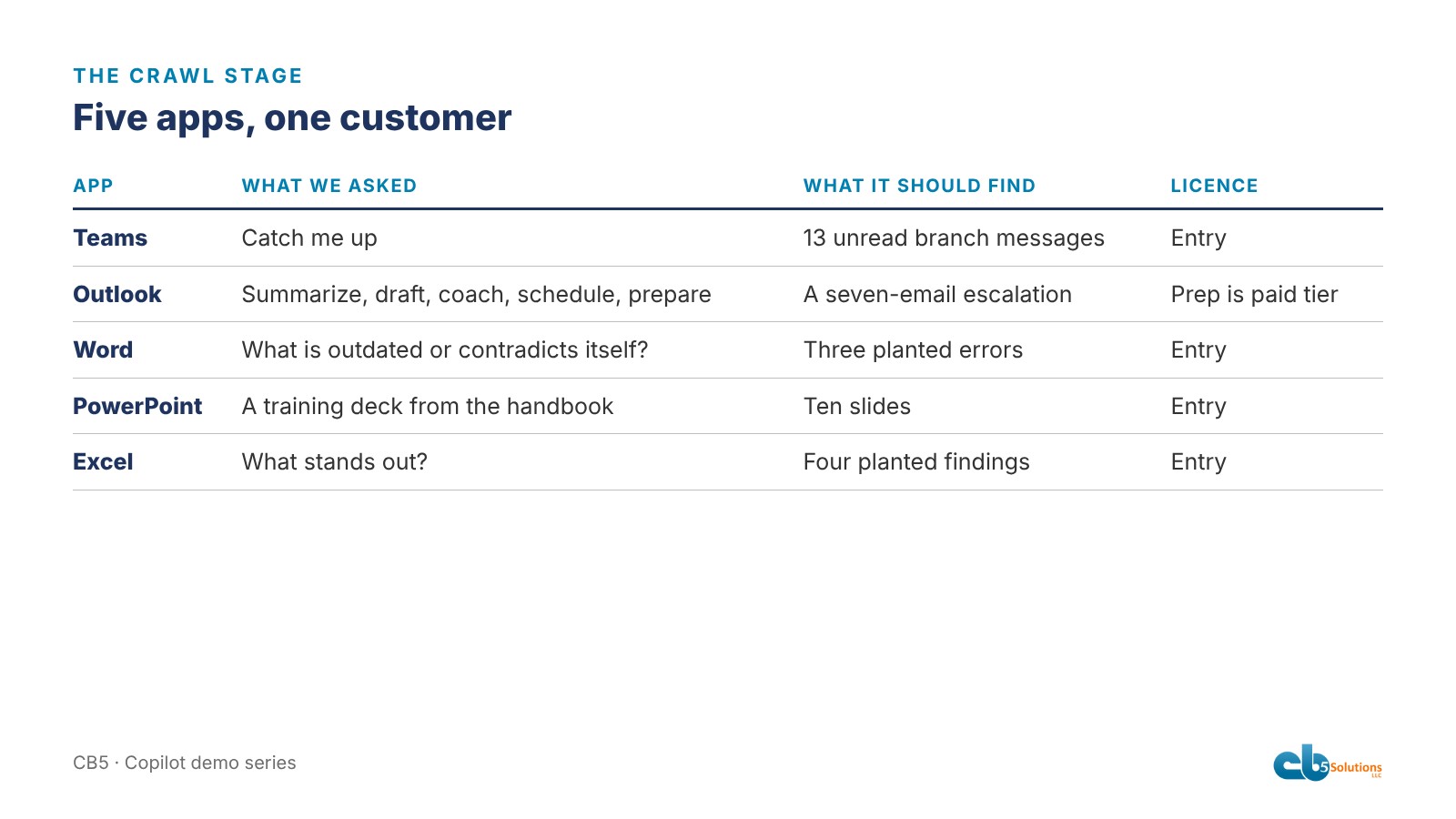
We opened in a Teams group chat called “Branch ops – Monday” with
thirteen unread messages. A colleague had seeded it that morning with
the kind of traffic a branch produces before 8 AM: a backorder, a tech
calling out, a customer escalation. The ask to Copilot was simply “catch
me up.”
This sounds trivial. It’s the single most used feature we see in the
field, and it lands with managers immediately because they all have that
chat. The lesson for the demo was logistical: the chat has to be
genuinely unread, so we had to ask a colleague to create it and not
touch it again. Small things like that are the difference between a demo
that looks real and one that looks staged.
Later in the same stage we showed a meeting recap. We had scripted a
mock huddle, then dropped it the day before in favour of a real internal
meeting we’d recorded that week. Real recaps have texture that scripted
ones don’t. We checked it for anything we wouldn’t want a client to see
first.
Outlook: the angry thread
The centre of the crawl stage was a seven-email thread from the
fictional maintenance manager at Kingsport Specialty Chemicals. Subject
line: “P-101 failed again: third seal since July.” It escalates the way
these threads do, from polite to pointed to “I need a plan by Monday or
I’m getting other quotes.”
We ran five beats against it. Summarize the thread. Draft a reply
that proposes a root-cause visit on a specific date. Run Copilot’s
coaching on a deliberately defensive draft we’d written, which is where
the room laughed, because everyone has sent that email. Schedule the
meeting from the thread. Then the one that separates the licence tiers:
“prepare me for my meeting with Kingsport.”
That last prompt is where we told the room the truth about
tiers. Summaries and drafts work on the entry licence.
Cross-source preparation, where Copilot pulls the thread, the calendar,
the files and the CRM into one brief, is the paid Microsoft 365 Copilot
licence. We’d rather say that in the demo than have someone discover it
after they’ve bought the wrong thing. It cost us nothing and it bought
credibility for everything that came after.
Word: a handbook with
three mistakes in it
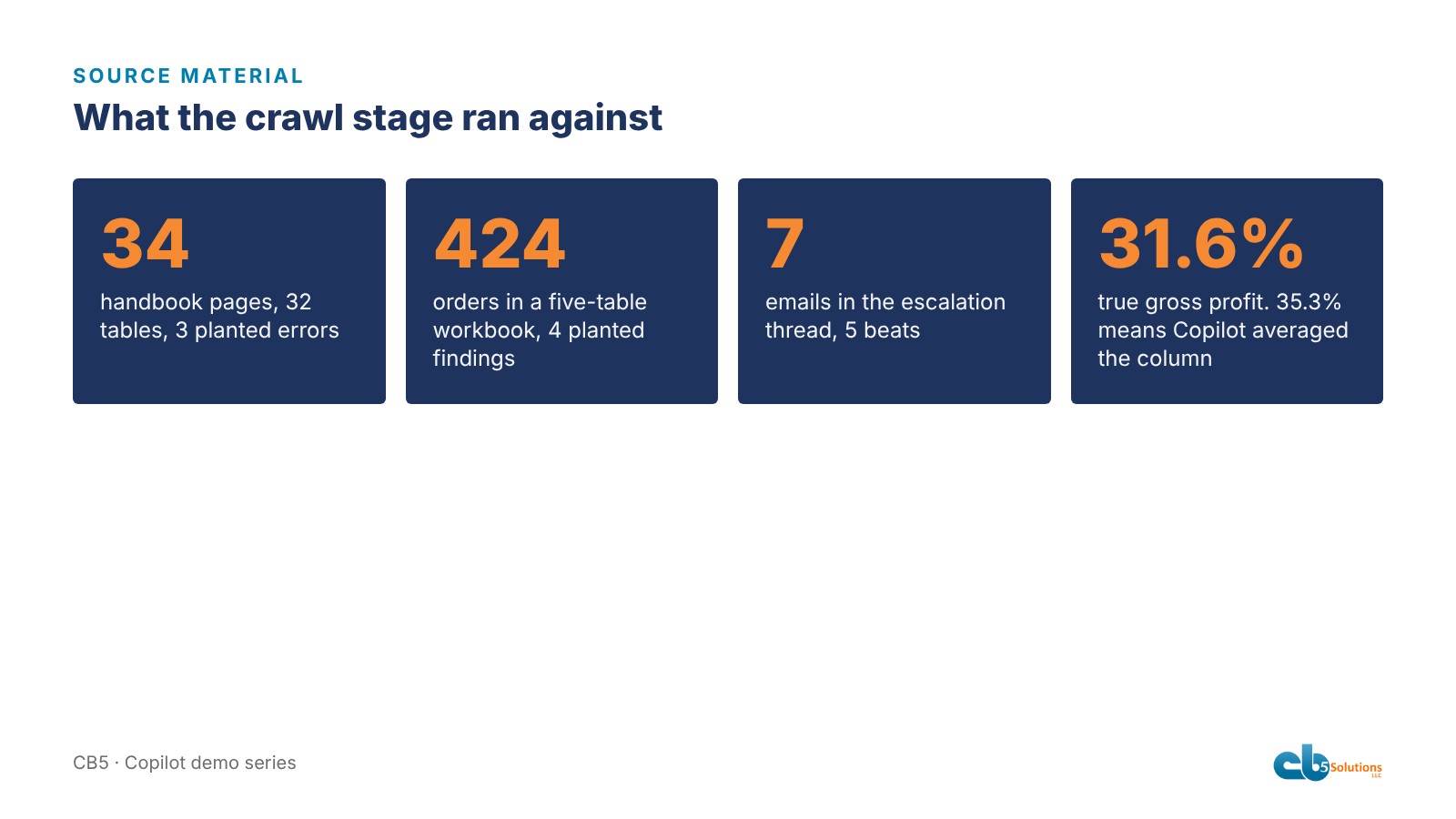
For Word we built a 34-page Pump Reliability Field Handbook.
Thirty-two tables, about 9,400 words, revision 4, the kind of document
every service organization has and nobody has read end to end since the
person who wrote it left.
We planted thirteen facts in it that the later demos would need, and
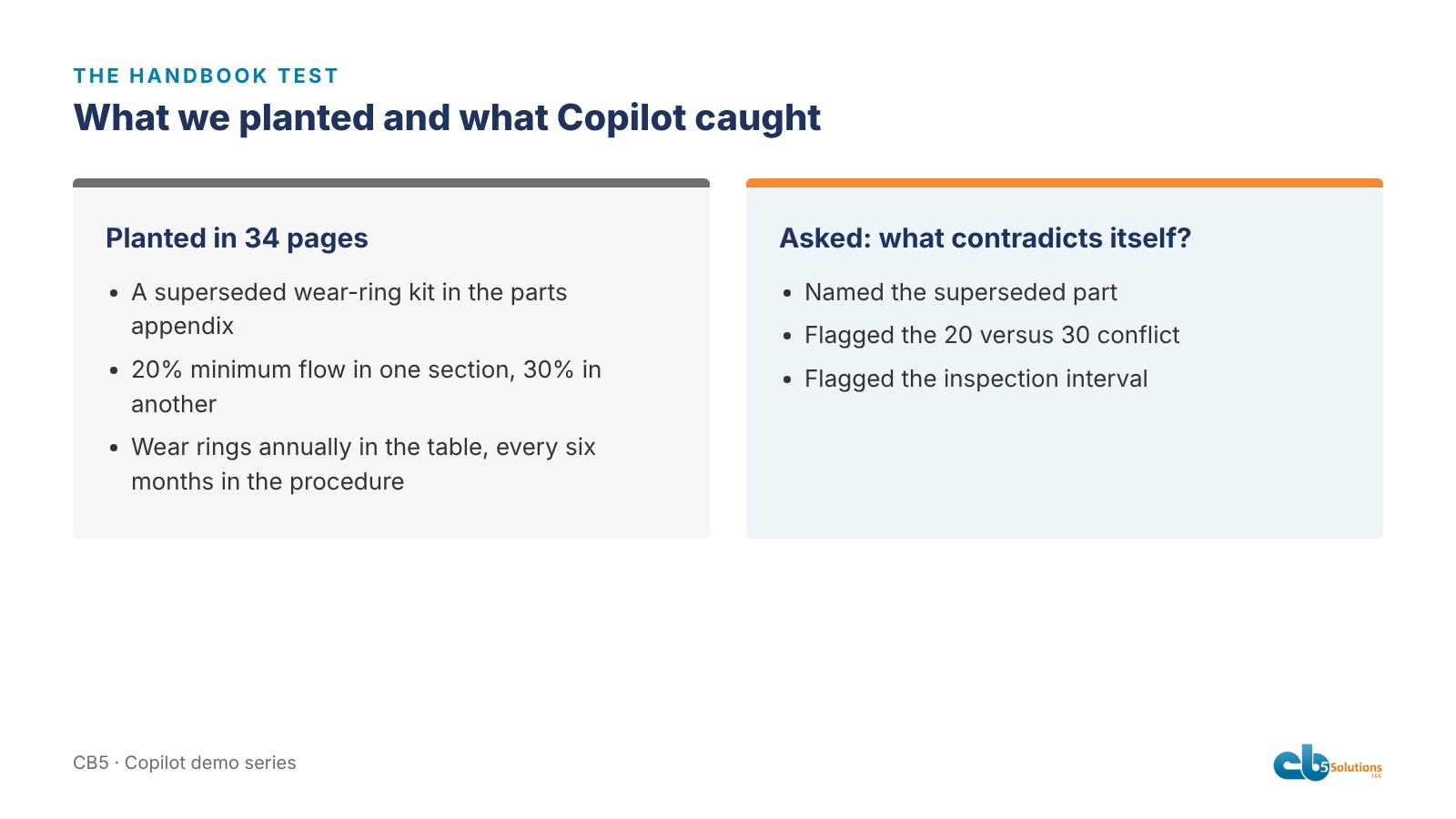
three errors:
- The parts appendix lists a superseded wear-ring kit instead of the
current hardened one. - One section says minimum continuous flow is 20 percent of best
efficiency. Another section, and the manufacturer’s manual, say 30
percent. - The preventive maintenance table says inspect wear rings annually.
The procedure three sections earlier says every six months.
The prompts were “summarize this,” then “what in here is outdated or
contradicts itself,” then “draft a letter to the customer from the
pre-visit notes.” The second prompt is the one worth watching. Copilot
in Word is good at summarizing. Asking it to find internal
contradictions is a harder test, and it’s a test that maps to real work:
every service manual has a 20-versus-30 problem somewhere.
We also used the handbook to make a point we’ll come back to in the
next post. When we built the live troubleshooting agent later in the
demo, we deliberately left the handbook out of its knowledge. The
handbook has a torque table in it. The manufacturer documents don’t. If
the agent could see the handbook, it would answer a torque question
confidently, and we needed it to say “that isn’t in my documents”
instead.
PowerPoint: a deck from a
document
Four prompts, kept short because this is the feature everyone has
seen. Generate a training deck from the handbook, tighten it, add
speaker notes, restyle it. We had a ten-slide backup deck in case
generation was slow, which is a habit worth adopting. Anything that
depends on a service call in front of an audience gets a backup.
Excel: four findings in 424
orders
Excel got the most time of the five, because it’s where distributors
actually live. We built a workbook with five named tables: 424 orders,
29 prices, 37 customers, 225 inventory rows, 48 service tickets. Fifteen
prompts, running from XLOOKUP and margin columns through a PivotTable, a
chart, a FILTER watchlist and a one-cell LET formula, to “what stands
out” and a Python forecast.
We planted four findings:
- One branch shipped 19 of 42 lines late, a 45 percent late rate
against under 8 percent everywhere else. - The seal the Kingsport pump keeps eating is below reorder point at
two branches, with two units left at the one closest to the
customer. - One customer is at 128 percent of its credit limit.
- Orders for that seal from Kingsport ran 7 in the first half of the
year and 29 in the third quarter alone.
That last one is the thread. It’s the first place in the demo where
the data, not a person, notices the seal problem.
There’s a check value in the run document that’s worth sharing
because it’s the kind of thing you only learn by rehearsing. Total sales
in the workbook are a little over five and a quarter million at 31.6
percent gross profit. If Copilot reports 35.3 percent, it averaged the
margin column instead of computing the ratio. A number that’s
wrong in a plausible way is more dangerous than one that’s obviously
wrong, and you need to know in advance which one your demo data will
produce.
What the crawl stage is for
None of this is new. Every Microsoft partner has shown Outlook
summarization. The difference is that all of it happened to one
customer, one pump, one angry manager, and by the end of the half hour
the room knew the Kingsport story cold without anyone having explained
it to them. The data had.
The general rule: the crawl stage is where you earn the right
to show the rest. If people don’t believe Copilot can summarize
their email or spot a contradiction in their own handbook, they will not
believe an agent can read their ERP. Start where the licence already is.
Be straight about what it costs to go further. Then go further.
Tomorrow, the walk stage: Microsoft’s Researcher and Analyst agents,
the Notebook that refuses to make up a price, and the agent we built
live in under four minutes.
Everything in this series uses fictional data built for the demo.
No customer, order, part number or dollar figure came from the
client.