A practical look at how a small real-estate-investing idea became a working rental-property analyzer through focused collaboration with AI tools. The lesson is not that AI replaces expertise. It is that a clear problem, steady iteration, and good guardrails can turn an idea into something useful much faster.
Most software ideas start with a sentence, not a specification. This one began with a straightforward question: Could I look at many properties at once and quickly understand which rental opportunities are worth investigating?
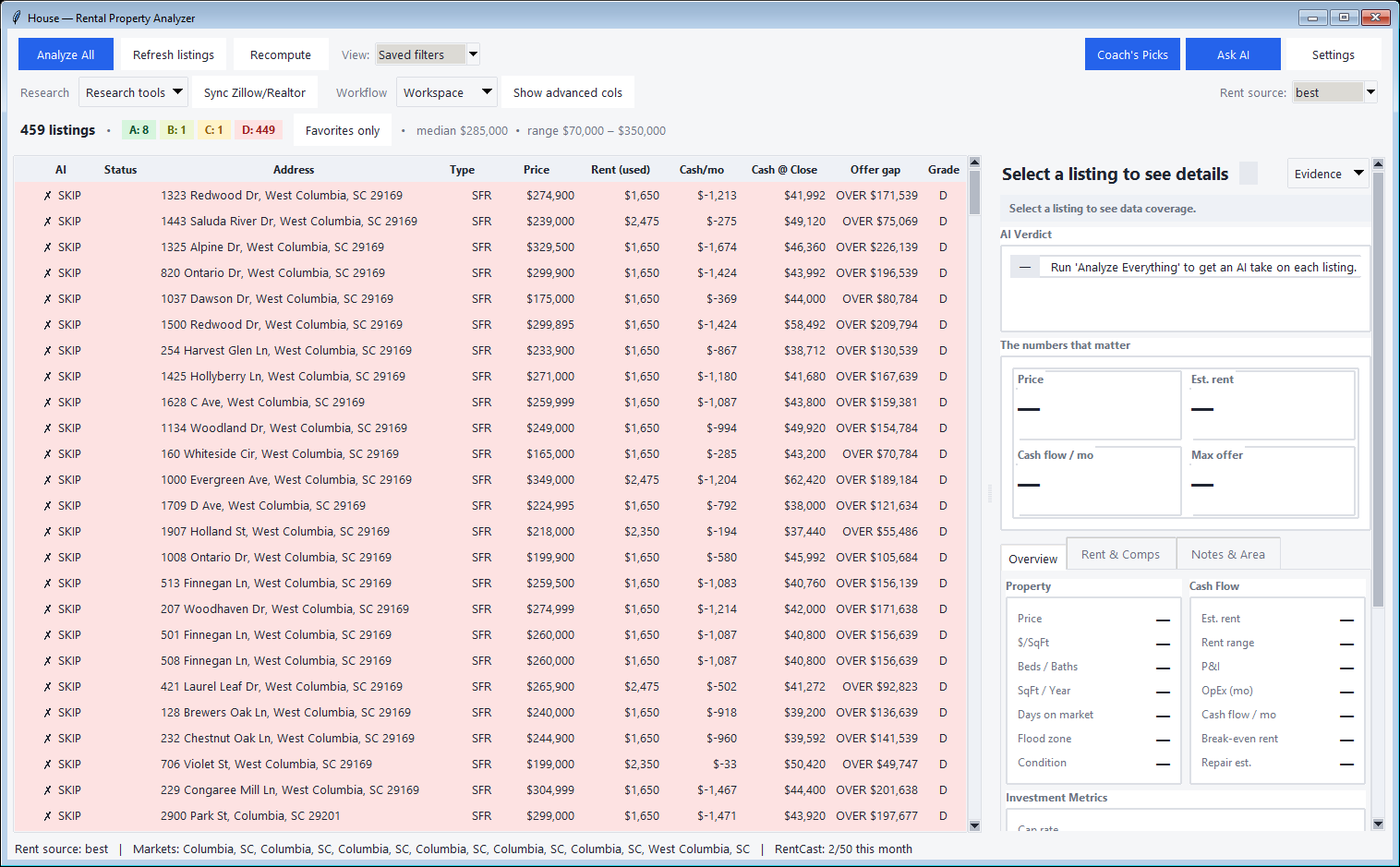
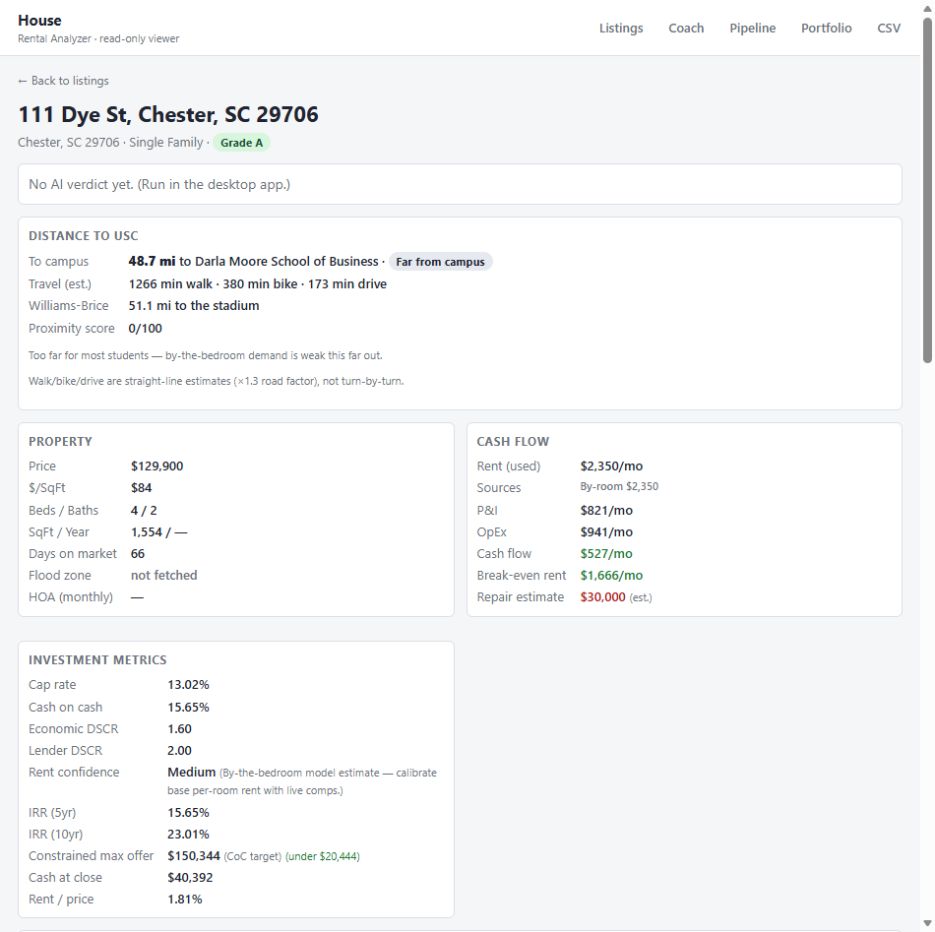
The answer became a working rental-property analyzer: a desktop application that brings listings, rent assumptions, operating costs, financing, repairs, risk factors, and investment metrics into one place. It screens opportunities, explains what data supports a recommendation, and makes it easier to see what should be toured, negotiated, or passed over.
The idea was simple. The useful version was not.
On the surface, the app could have been a spreadsheet with a few formulas. In practice, a usable underwriting tool needs to handle more than a purchase price and a rent estimate. It needs to be clear about assumptions, defensible about data, and honest about uncertainty.
- Screen active home and land listings with property-type filters.
- Calculate cash flow, cap rate, cash-on-cash return, maximum offer, and both lender and economic DSCR.
- Account for financing, taxes, insurance, vacancy, management, maintenance, capital reserves, repair budgets, and closing costs.
- Show rent evidence from Zillow estimates, HUD data, and manual assumptions.
- Capture active rental comparables, price history, tax history, and local assessor links for deeper review.
AI was the accelerator, not the owner of the decision.
Claude, ChatGPT, and Copilot were used as collaborators during the process. They helped turn rough requirements into code, identify edge cases, review calculations, improve the interface, and keep a long list of features organized into working phases. The goal, constraints, and decisions stayed grounded in the real workflow the app was meant to support.
That did not mean blindly accepting generated output. The application was built with verification in mind. The underwriting logic is testable, calculations are separated from the user interface, and the app makes missing or questionable data visible instead of quietly treating it as fact.
For example, a rent estimate now includes evidence and confidence information. A repair condition can be selected and converted into an explicit repair budget. Land is handled differently from a rental home instead of being pushed through calculations that do not apply. API failures, inactive subscriptions, stale cached listings, and missing keys appear in a Config Health view rather than disappearing into the background.
Building for real-world uncertainty
One of the most valuable improvements came from treating data quality as a feature. Real-estate data sources can be incomplete, rate limited, incorrectly configured, or simply unavailable. A useful app needs to handle that gracefully.
The analyzer distinguishes between what is known, what is estimated, and what needs follow-up. It can show when a rent assumption is backed by Zillow, RentCast, HUD, or a manual entry. It can flag a missing Census key, report an inactive RentCast subscription with a clear recovery path, and continue the rest of the analysis when an optional enrichment source is unavailable.
A fast answer is helpful. A fast answer with visible assumptions is far more useful.
The bigger takeaway
The most exciting part of this project is not a single feature. It is the proof that a useful internal tool can begin as a simple idea when the builder stays close to the problem and uses AI deliberately.
AI can help teams move faster through drafting, coding, testing, reviewing, and refining. But the value still comes from defining the workflow, setting the standards, checking the math, and being transparent about limitations. The tools can accelerate the work, but people still supply the judgment.
For CB5, that is a familiar principle. Technology is most valuable when it solves a real problem, respects the people using it, and leaves the organization more capable than before.
Note: This application supports property screening and underwriting research. It does not replace property inspections, lender requirements, legal review, market due diligence, or professional financial advice.